

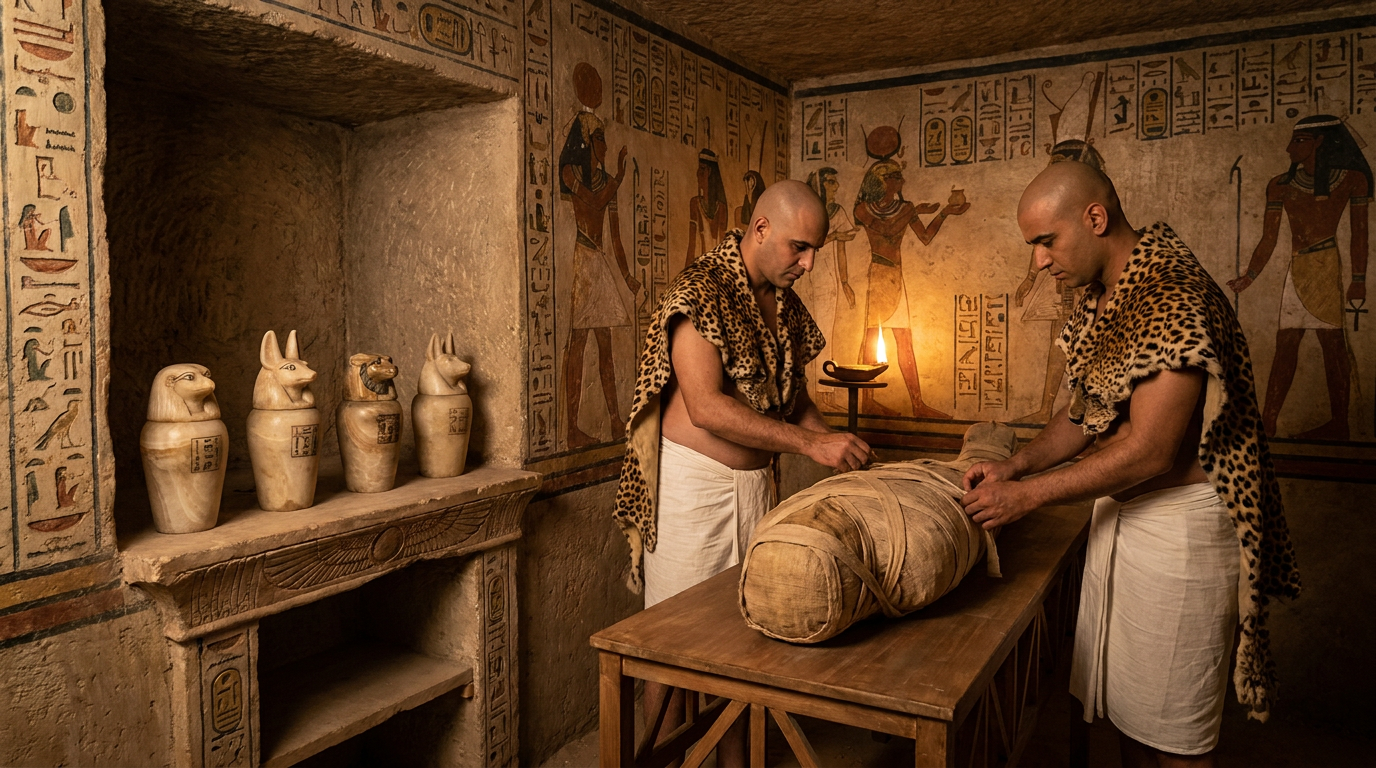
The ancient Egypt mummification process ran roughly 70 days across three stages: removing the organs, drying the body in natron salt, then wrapping it in resin-soaked linen. Herodotus recorded this timeline after visiting Egypt, and CT scans of real mummies mostly back him up. Here is the step-by-step version, plus where the manual and the actual bodies disagree.
Why the process took exactly 70 days
Herodotus wrote that embalmers spent 70 days on a body before burial. That number was not arbitrary. It likely tracked the disappearance and return of Sirius, a star cycle tied to Osiris and rebirth.
CT and X-ray studies of Middle and New Kingdom mummies show stages that mostly fit inside that window, though poorer burials were often rushed. Not every mummy got the full 70 days. Rank in Egypt’s social pyramid decided how much time a family could afford.
Step one: removing the organs
Embalmers opened the left side of the abdomen with an obsidian blade and pulled out the stomach, liver, lungs, and intestines. Each organ went into its own container once dried and treated, as our breakdown of canopic jars covers in detail.
The heart stayed inside the body. Egyptians believed it held memory and judgment, so it needed to travel intact into the afterlife weighing ceremony.
Step two: pulling the brain out through the nose
The brain got no such respect. Embalmers considered it useless, so they broke through the ethmoid bone at the top of the nasal cavity with a hooked tool and drew the tissue out in pieces.
CT scans of royal mummies, including Tutankhamun, show damage to the nasal passage consistent with this method, plus resin poured into the empty skull afterward.
Step three: forty days in natron
Once the body was empty, embalmers packed it inside and out with natron, a salt mixture of sodium carbonate and sodium bicarbonate mined from dry lakebeds. It pulled moisture from the tissue and stopped bacterial decay.
This drying stage ran about 40 days on its own. By the end, the body had shrunk visibly and lost most of its water weight, exactly what scans of preserved remains show today.
Step four: stuffing, oils, and wrapping
After the natron came out, embalmers packed the shrunken cavity with linen, sawdust, or resin-soaked padding to restore a lifelike shape. Skin got treated with oils to stay flexible enough for wrapping.
Then came hundreds of yards of linen strips, wound layer by layer with amulets tucked between them. A final coat of resin sealed and waterproofed the wrapping for burial.
Priests carried out these rites while ordinary Egyptians kept living on the same staples described in our piece on what ancient Egyptians actually ate, a reminder that this whole ritual sat inside a working, hungry society.
Where the manual and the mummy disagree
Herodotus described the process from the outside, likely through priests who had reason to make it sound uniform and sacred. Real bodies tell a messier story.
Some mummies show organs left inside, rushed drying, or wrapping over decayed tissue, especially in lower-status burials or unstable periods. The 70-day figure is the ideal, not every case that went through a workshop.
Frequently asked questions
How long did ancient Egyptian mummification really take?
Herodotus put the full process at 70 days, split between organ removal, roughly 40 days of natron drying, and final wrapping. CT scans of well-preserved mummies generally support that range, though cheaper burials took shortcuts.
Why did embalmers remove organs during mummification?
Removing the stomach, liver, lungs, and intestines stopped the fastest sources of decay. Each organ was dried and stored separately, most often in canopic jars, while the heart stayed in place for the afterlife judgment.
What did natron do to the body during mummification?
Natron drew moisture out of the tissue over about 40 days, stopping bacteria from breaking the body down. It is the same drying principle behind salt-cured food, just applied at a larger, more deliberate scale.