

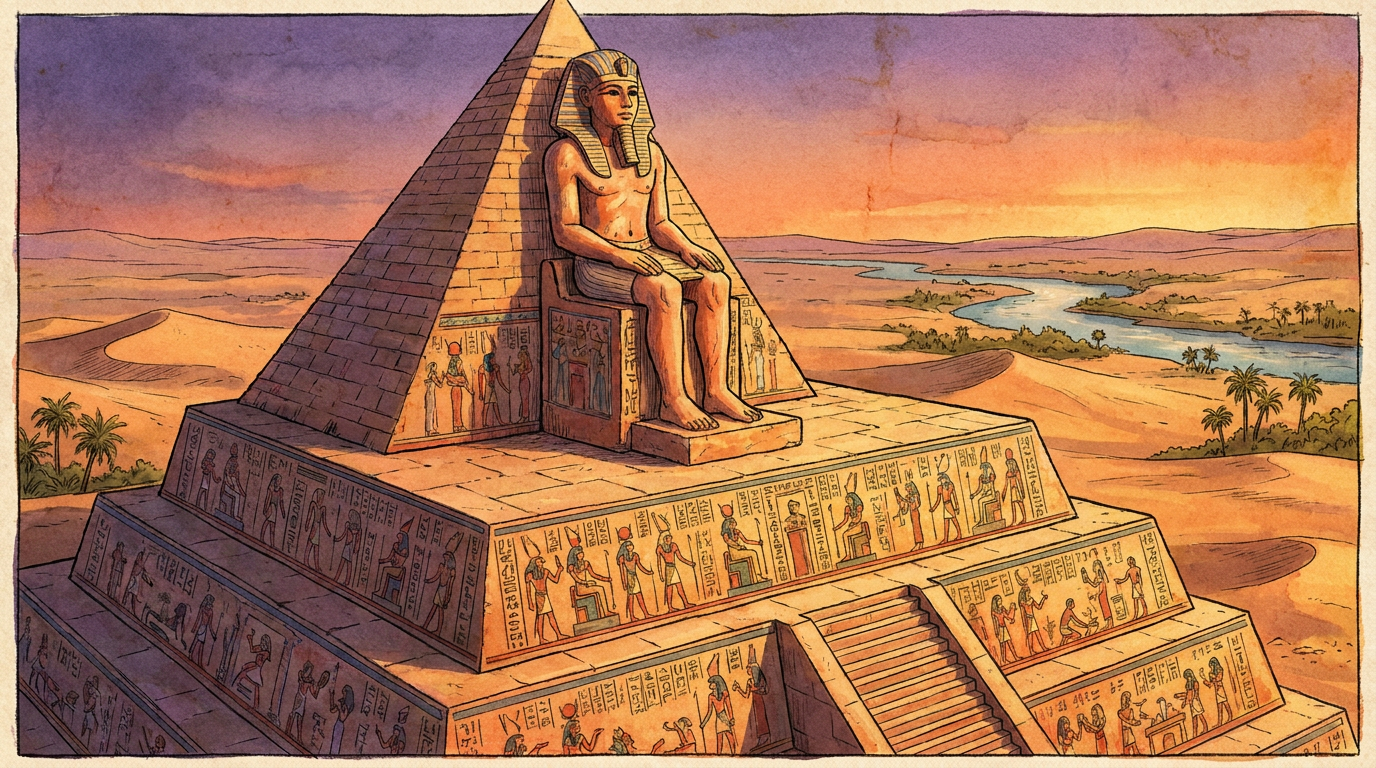
The ancient Egypt social pyramid ranked society from the pharaoh at the top down to farmers and enslaved workers at the base. But the tidy triangle drawn in most classrooms hides the part that actually ran the country: a thin layer of officials, priests and scribes who held real day-to-day power far beyond their numbers.
Look closer and the hierarchy is less a smooth slope and more a series of hard steps. Here is who sat where, and who really pulled the levers.
The pharaoh: god and government in one person
At the very top stood the pharaoh, seen not just as a king but as a living link between the gods and the people. In theory he owned the land, commanded the army and set the law.
In practice one person could not run a kingdom that stretched along the entire Nile. That gap is exactly why the next layer mattered so much.
Viziers and officials: the people who actually ran Egypt
Below the pharaoh sat the vizier, a kind of prime minister who managed taxes, courts and building projects. Regional governors and a web of officials carried out his orders across the provinces.
These men were not royalty, yet their signatures moved grain, labour and money. If you wanted anything done in Egypt, you dealt with this class, not the god-king above them.
Priests and scribes: literacy was power
Priests controlled the temples, which were also huge economic engines holding land, workshops and stores of grain. Managing that wealth gave them influence that outlasted individual kings.
Scribes sat just below, and their advantage was simple: they could read and write in a society where almost no one else could. That single skill lifted a scribe’s son far above a farmer’s. This link between literacy and status shows up again and again in the wider science and history explainers we cover.
Soldiers, artisans and merchants: the working middle
Craftsmen who built tombs and made goods held a respected middle position, especially the skilled workers of royal projects. Soldiers could climb through service and loot, and merchants moved trade along the river and beyond.
This middle band is the part the simple chart flattens most. It had real mobility, something the base almost never did.
Farmers and the enslaved: the foundation
The vast majority were farmers who worked the land, paid taxes in grain, and were called up for state projects when the Nile flooded and fields sat idle. Enslaved people, often prisoners of war, sat at the very bottom.
Their labour fed everyone above them. Curious how that food actually looked on the plate? See our companion piece on what ancient Egyptians actually ate, and browse more from the Nomad Labs homepage.
Frequently asked questions
Who was at the top of the ancient Egypt social pyramid?
The pharaoh, who was viewed as a divine ruler linking the gods and the people. Directly below him the vizier and senior officials handled the actual running of the kingdom.
Could people move up the social pyramid in ancient Egypt?
Some could, mainly through becoming a scribe, joining the army, or skilled craft work. Farmers and enslaved people at the base had very little chance of rising.
Why were scribes so important in ancient Egypt?
Because they could read and write when almost no one else could. That skill made them essential to tax records, law and administration, giving them status well above ordinary workers.