

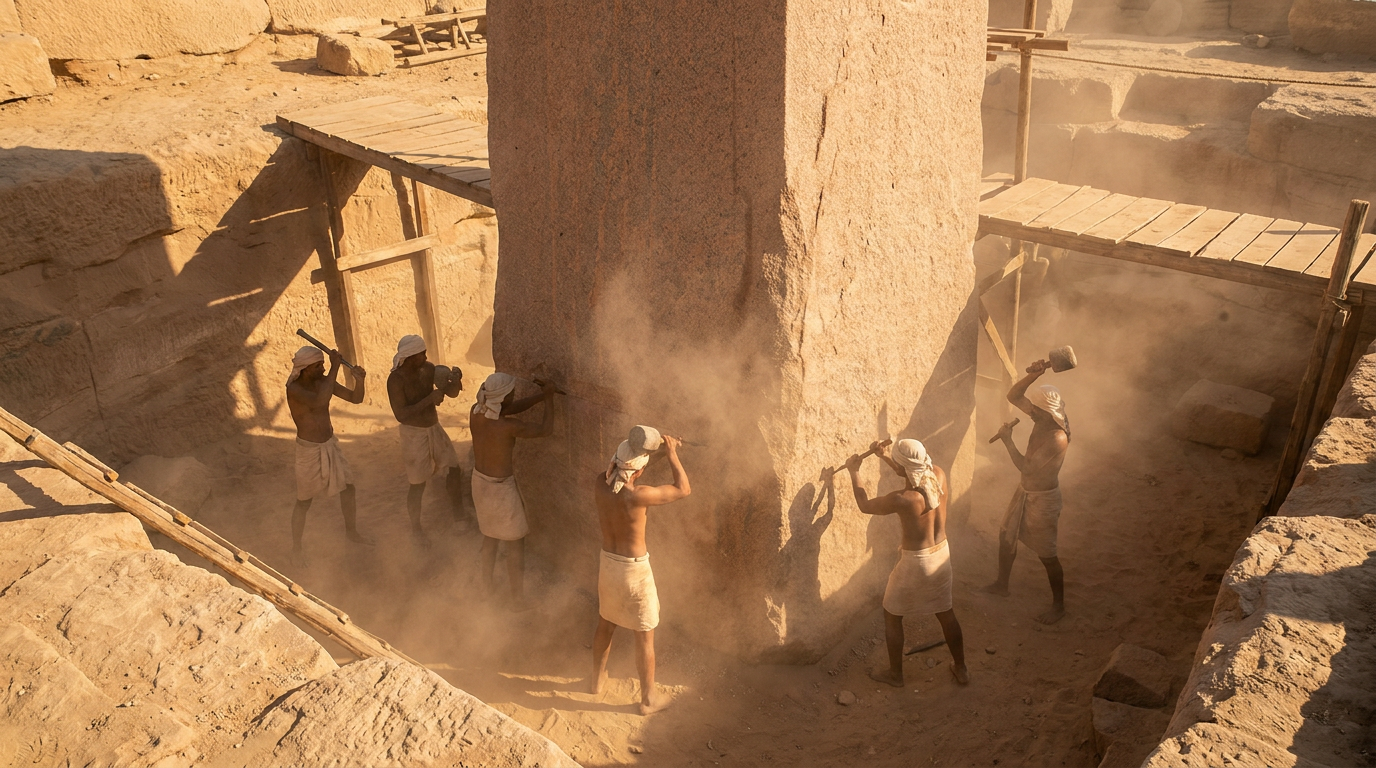
Egyptians built obelisks by cutting a single block of Aswan granite free from bedrock with dolerite pounding stones, then floated the finished monolith down the Nile on a barge during flood season. No crane or metal chisel touched the granite. Every cut came from repeated pounding and abrasive sand.
That process meant an obelisk had to survive two ordeals: coming free from the quarry without cracking, then riding a river current with a granite shaft weighing well over 100 tons. Here is how both stages worked, and why one obelisk never made the trip.
How Did Workers Cut an Obelisk Free From the Quarry?
At Aswan, workers traced the obelisk’s outline onto exposed granite, then pounded a trench around all four sides using rounded dolerite hammerstones, a rock harder than granite itself.
No iron or bronze tool could hold an edge against granite, so the trench relied on brute abrasion: strike, crush, sweep debris, repeat. Freeing the underside, the hardest step, came last.
What Is the Unfinished Obelisk at Aswan?
The unfinished obelisk still lying in its Aswan quarry bed shows this method mid-process. Trenches run along three sides, but a crack appeared in the granite before workers finished, and the block was abandoned where it lay.
Completed, it would have stood taller than any obelisk ever erected in Egypt, the clearest surviving evidence of how narrow the margin for error really was.
How Did Egyptians Move an Obelisk to the River?
Canals were cut from the quarry toward the Nile so a loaded barge could reach water without a long overland haul across sand. Workers moved obelisks during the annual flood, when high water shortened the distance a crew had to drag the block over dry ground.
Sledges, ropes, and packed earth tracks likely handled that land segment, the same principle behind hauling pyramid blocks without iron tools, though a single-piece obelisk made every pull riskier.
How Did the Barge Carry an Obelisk Down the Nile?
A relief at Hatshepsut’s Deir el-Bahari temple shows a wide, flat barge carrying two obelisks stern to bow, towed by a fleet of smaller boats rowing in formation.
The hull needed exceptional strength to keep a granite load from shifting or splitting it. There is no consensus on how the barge was loaded in the first place. One proposal has it floated into a canal and positioned beneath the obelisk on temporary supports, removed as water rose. That remains a working theory, not a confirmed record.
How Did Egyptians Raise an Obelisk Upright?
Standing a granite shaft upright at a temple site was a separate problem from quarrying or transport. Ramps built against the base, paired with sand-filled pits drained gradually to lower the obelisk into place, are the leading explanation, in the same spirit as the ramp debates around how the pyramids were really built. No single method is proven.
Why Does the Obelisk Rank Among Egypt’s Hardest Engineering Feats?
A stacked pyramid tolerates a damaged block; you swap it out. An obelisk is one continuous piece of stone from base to tip, so a single crack at any stage ruined months of labor.
That single-block risk puts obelisk-building in the same conversation as other extreme stone-moving feats, including the trilithon blocks at Baalbek, where the scale still challenges modern explanations of ancient logistics.
Frequently Asked Questions
How heavy was a typical ancient Egyptian obelisk?
Weights varied by height and quarry source, with completed obelisks commonly cited in the range of dozens up to roughly 100+ tons for the largest examples.
Why is the unfinished obelisk at Aswan still in the quarry?
A crack developed in the granite during trenching, and workers abandoned it rather than risk the whole block. It remains attached to bedrock today.
Did the Egyptians use the wheel to move obelisks?
No. Evidence points to sledges, ropes, packed sand tracks, and river transport rather than wheeled carts for loads this heavy across sand and riverbank terrain.