

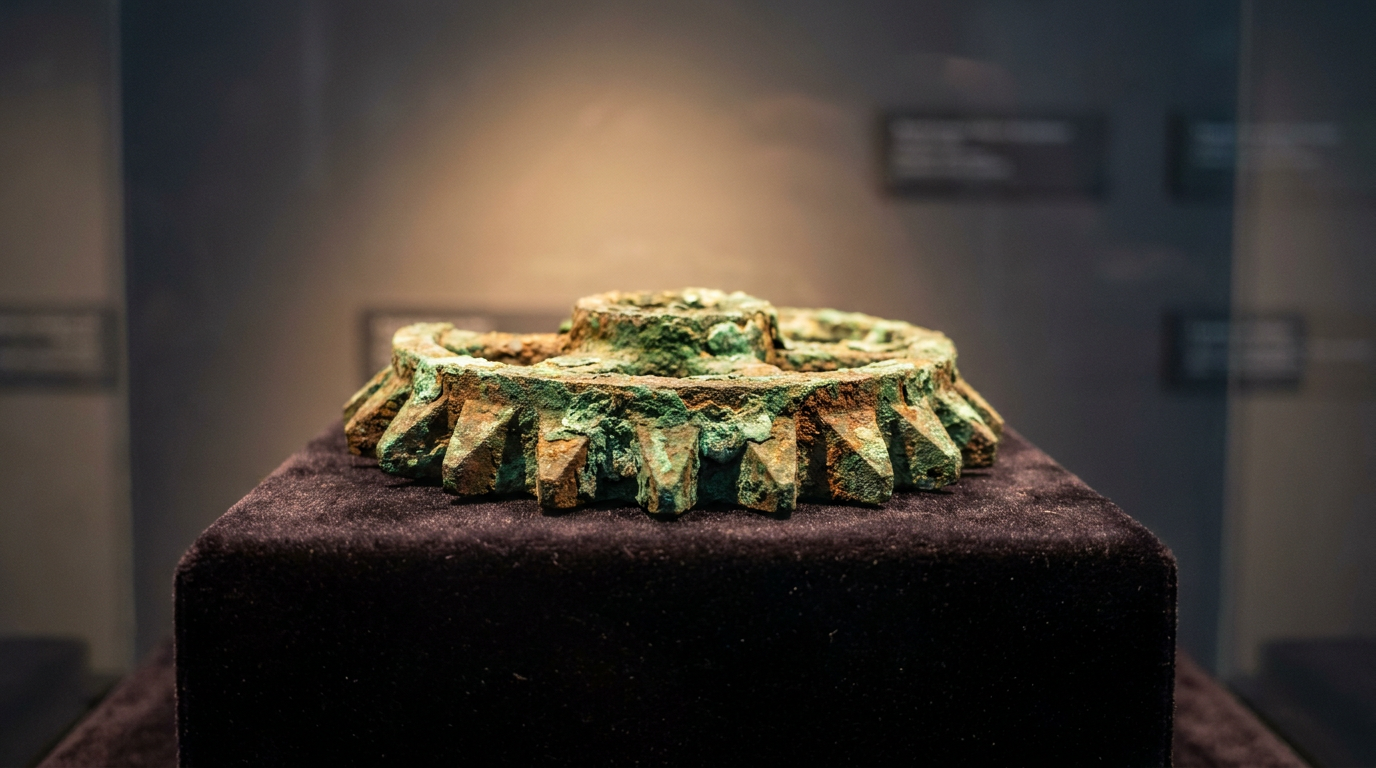
The Antikythera Mechanism is a corroded bronze gear system, roughly the size of a shoebox, that ancient Greek engineers built to calculate the positions of the Sun and Moon and predict eclipses decades in advance. Sponge divers pulled it from a shipwreck off the island of Antikythera in 1901. Nothing else this mechanically complex shows up again in the archaeological record for over a thousand years.
That gap is why the object keeps resurfacing in every conversation about lost ancient knowledge. You do not need a conspiracy theory to find it startling. The real engineering behind it is strange enough on its own.
What Divers Found Off Antikythera in 1901
A team of Greek sponge divers working a Roman-era shipwreck near the small island of Antikythera recovered a shapeless lump of corroded bronze along with statues, coins, and other cargo. The lump sat in storage for years before anyone noticed the gear teeth pressed into its surface.
Once conserved and studied, it turned out to hold dozens of interlocking bronze gears, packed into a wooden case smaller than a modern laptop. Researchers date the mechanism to roughly the 2nd century BC, making it far older than any comparable geared device known from Europe.
What the Bronze Gears Actually Track
The gear train inside the mechanism was built to model the Metonic cycle, a 19-year pattern that lines up the solar year with the lunar month. That same gearing also tracks the Saros cycle, the roughly 18-year rhythm behind solar and lunar eclipses.
Dial pointers on the front and back faces would have shown the position of the Sun and Moon against the zodiac, letting whoever operated it read off eclipse timing without watching the sky for decades first. That is calendar science and astronomy compressed into moving metal, centuries before mechanical clocks existed anywhere else.
The 2021 UCL Reconstruction That Finally Made Sense of It
For over a century, researchers could see the gears but could not agree on how the front display fit together, since large sections of the original casing never survived the shipwreck. In 2021, a UCL-led team headed by Tony Freeth published a computational model of the front gearing in the journal Scientific Reports.
Their model reconstructed how the surviving gear teeth and inscriptions could drive a coherent display of the Sun, Moon, and known planets, resolving a puzzle that earlier physical reconstructions had never fully closed. It did not invent new parts. It worked out how the parts that survived were meant to move together.
Why Real Greek Engineering Beats Any Lost-Civilization Story
You will find plenty of claims online that the mechanism proves a vanished advanced civilization. The mainstream evidence points somewhere more interesting: Hellenistic Greek astronomers and instrument makers combining known mathematics into a single physical device, using bronze-working skills documented elsewhere in the same era.
That puts it in the same category of question as how the pyramids were really built or how the Egyptians moved multi-ton obelisks. Each case shows ancient builders solving problems with tools historians once assumed were beyond them, not outside help from anywhere else. The same pattern shows up across the megalith sites that still defy easy answers, where the mystery is craftsmanship, not origin.
Frequently Asked Questions
What is the Antikythera Mechanism used for?
It functioned as an astronomical calculator, tracking the Metonic and Saros cycles to predict the positions of the Sun and Moon and the timing of eclipses.
How old is the Antikythera Mechanism?
Researchers date it to roughly the 2nd century BC, based on the shipwreck context it was recovered from off the Greek island of Antikythera.
Did the 2021 UCL study find new gears or evidence?
No. The Freeth-led team built a computational model explaining how the surviving gears and inscriptions could drive the front display, resolving a long-standing reconstruction puzzle rather than uncovering new physical parts.