

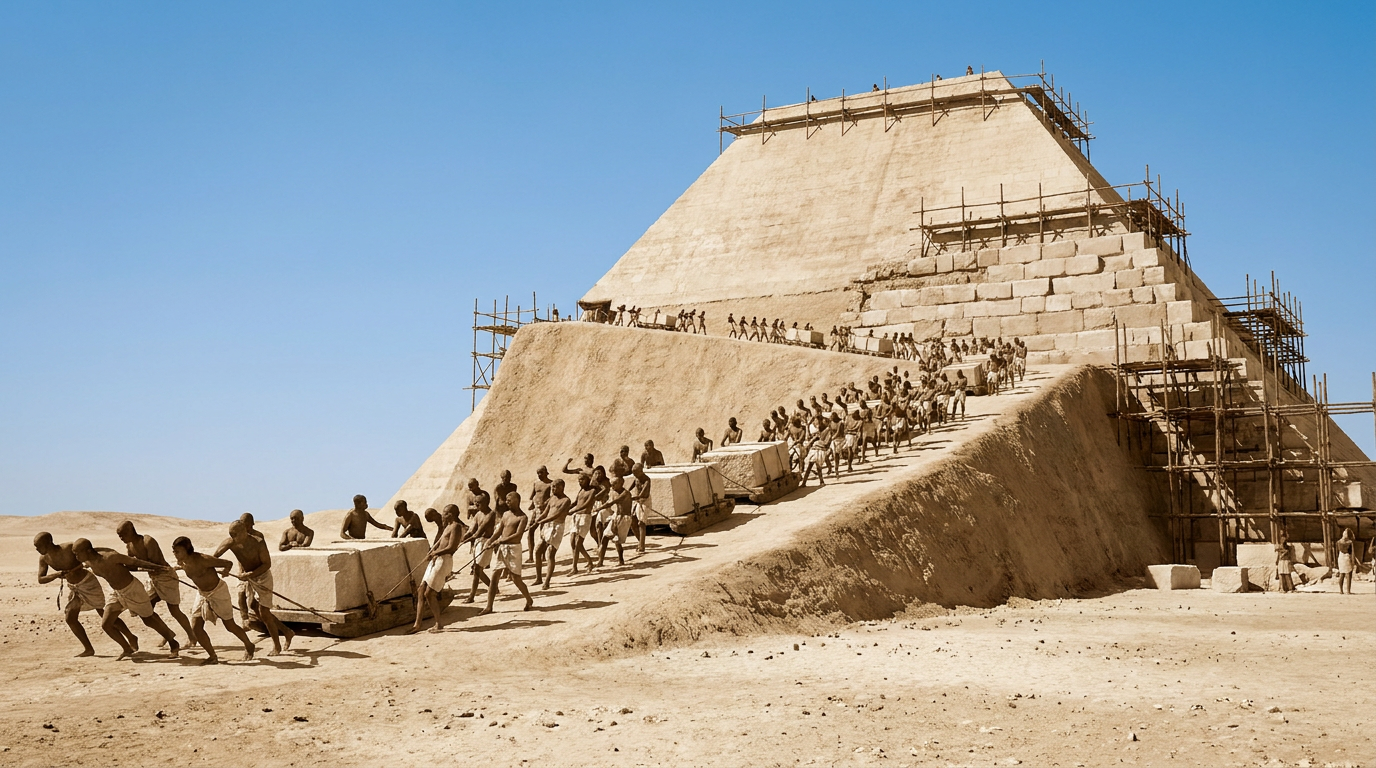
The mainstream, evidence-backed answer is that Egyptian builders moved most of the Great Pyramid’s limestone blocks using teams of laborers hauling sledges over wetted sand, up ramps built from mudbrick, gypsum, and rubble. Most of the stone came from a quarry at Tura, across the Nile, floated over by boat before the final haul to the plateau. No aliens, no lost machines. Just organized human labor, seasonal flood water, and centuries of stoneworking skill.
That answer sounds almost too plain for a monument this size. Here is where the theories genuinely differ, what the physical evidence shows, and why one papyrus find changed the conversation more than any documentary ever did.
What the Ramp Theories Actually Propose
Egyptologists agree ramps did the heavy lifting, but they disagree on the shape. The straight ramp theory has workers extending one incline up a single face as the structure grew taller. The problem is volume: a ramp long enough for a workable slope at full height would need more material than the pyramid itself.
The zigzag ramp theory solves that by spiraling the incline around the exterior faces, using far less material, though critics note it would obscure the corners needed to check alignment mid-build. A newer variant, the internal ramp theory, argues for a spiral ramp hidden inside the core, popularized by French architect Jean-Pierre Houdin. It is intriguing but unconfirmed, since testing it would mean damaging the monument.
Why the Water and Canal Theory Keeps Resurfacing
The water theory does not claim the pyramid floated. It claims Egyptians used canals and basins linked to the Nile to move quarried stone close to the site by boat, cutting the overland drag distance. Satellite and radar surveys around Giza have identified what look like ancient waterways and a harbor basin, lending this theory real support. It does not replace the ramp theory, it explains the last-mile logistics rather than the vertical lift.
What the Tura Limestone Quarries Tell Us
The fine white limestone used for the outer casing came from quarries at Tura, across the Nile from Giza, while rougher core blocks were often quarried locally. Tool marks, extraction trenches, and worker graffiti at Tura confirm organized, state-directed quarrying at scale, with copper chisel marks still visible in exposed rock faces. This is one of the most physically confirmed parts of the entire pyramid-building process.
What the Wadi al-Jarf Papyri Prove
In 2013, archaeologists discovered papyrus fragments at Wadi al-Jarf, a Red Sea harbor site. Among them was the logbook of an official named Merer, who oversaw a crew transporting limestone from Tura to Giza during the reign of Khufu, describing daily trips down waterways and reporting to overseers by name.
This is the oldest known inscribed papyrus in the world, a firsthand administrative record rather than a legend passed down later. It does not settle the ramp debate, but it confirms the logistics chain the water theory depends on: organized transport run by a real bureaucracy with named officials, the same state coordination visible in ancient Egyptian architecture well beyond Giza, and in the specialized ancient Egyptian inventions that made large-scale building possible.
So How Were the Pyramids Really Built
Put together, the evidence points to a layered system, not one single method: quarrying at Tura and locally, river and canal transport now documented in Merer’s own words, ramps moving blocks the final stretch upward, and sledges over wetted sand cutting friction on the ground.
None of this required lost technology. It required a centralized state that could feed, house, and coordinate tens of thousands of workers for decades, arguably more impressive than any single engineering trick. The same pattern shows up across other ancient megalith engineering debates, where the real story is logistics, not mystery.
Frequently Asked Questions
Did the ancient Egyptians use slaves to build the pyramids?
Worker cemeteries found near Giza point to paid or conscripted laborers, not enslaved people, organized in rotating crews with rations and medical care.
What is the Wadi al-Jarf papyri exactly?
Papyrus fragments found at a Red Sea harbor in 2013, including a logbook kept by official Merer describing limestone shipments to the Great Pyramid.
Is the ramp theory or water theory correct?
Both, in different roles. Canals moved stone toward the site, while ramps handled the vertical lift once blocks reached the plateau.