

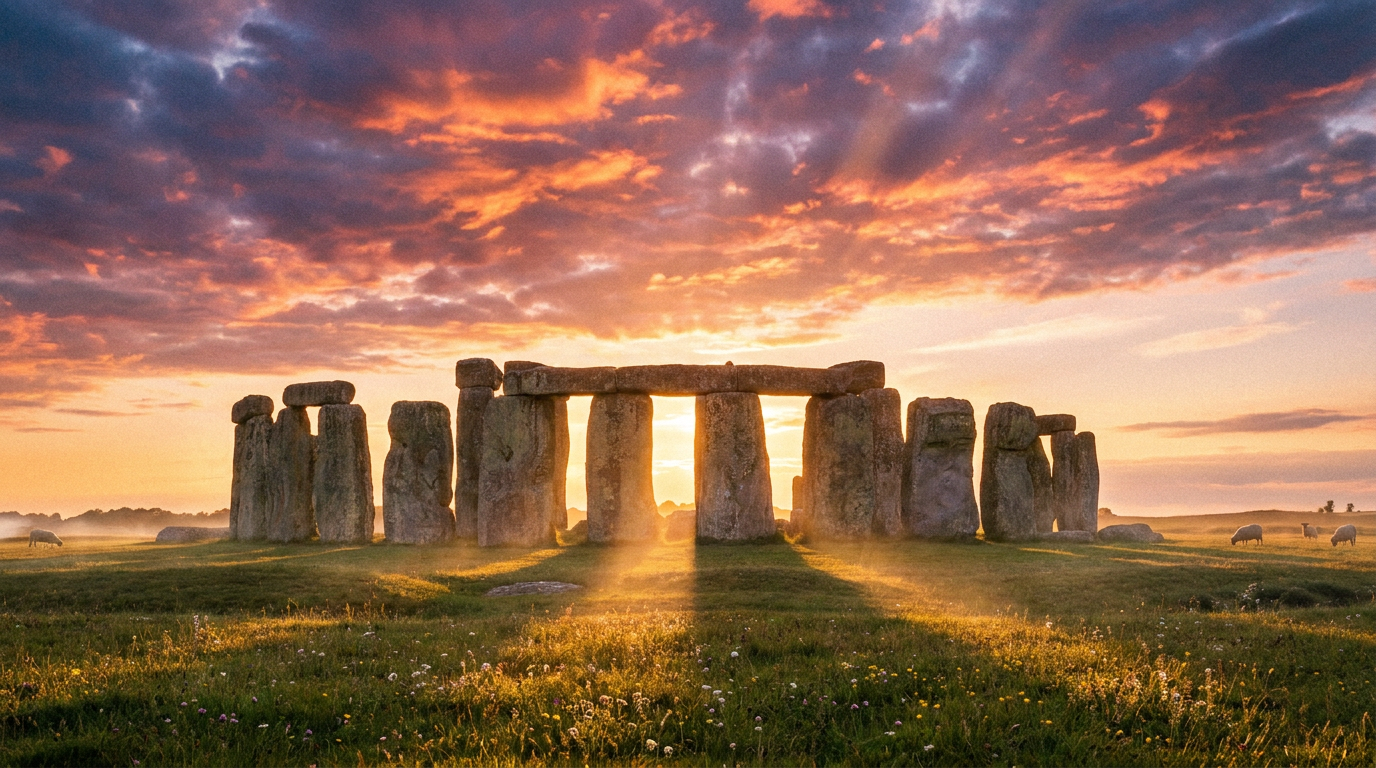
Neolithic farming communities in Britain built Stonehenge, working in phases across several centuries starting around 5,000 years ago. No Druids, no Romans, no lost civilization, and no aliens were involved. That part is settled among archaeologists. What is not settled, and what keeps papers and documentaries coming, is how those communities moved the stones and organized the labor.
You’ve probably seen the Druid theory floated online. It’s wrong by a wide margin. Stonehenge was already roughly 2,000 years old when Druids show up in the historical record, so they inherited the monument rather than built it.
The Timeline: Why “Built in Stages” Matters
Stonehenge wasn’t one construction project. Excavations show it developed over roughly 1,500 years, starting with an earthwork enclosure and early timber or stone posts, then evolving through rebuilding phases into the circle you recognize today. Different generations, likely from related but distinct communities, contributed to different phases, which is why there’s no single architect or tribe to credit.
Who Moved the Bluestones from Wales?
The smaller stones, known as bluestones, come from the Preseli Hills in west Wales, roughly 150 miles from Salisbury Plain. Geologists matched the mineral makeup of specific outcrops there to stones on site, solid archaeological sourcing by any standard.
The debate centers on the “how.” One camp argues Neolithic people hauled the multi-ton stones overland on timber sledges and log rollers. Another has argued for a route partly by water, using rafts along coastlines and rivers before a final overland stretch. Neither is proven, and researchers who study megalith construction methods at other prehistoric sites keep hitting the same wall: physical evidence for the journey rarely survives, so scholars reconstruct a route from indirect clues.
What About the Larger Sarsens?
The bigger stones, forming Stonehenge’s outer circle and trilithons, weigh up to 25 tons and traveled a shorter distance. Chemical analysis traced most to West Woods, about 15 miles north of the site.
Fifteen miles sounds manageable, but moving a 25-ton block that far without wheels or trained animals is still a massive undertaking. Experimental archaeology, where researchers physically replicate ancient techniques, shows sledges on greased timber tracks can move stones that size with a large coordinated team. That proves the method is plausible, not that it’s what actually happened.
Why Archaeologists Still Argue About the Details
The “who and how” question stays open because the builders left no written records. Everything researchers know comes from excavated remains, stone sourcing, and comparison with other Neolithic sites, including the puzzles at Baalbek’s massive stone platform in Lebanon.
New excavation techniques keep revising details. One widely discussed theory proposes that some bluestones originally stood in a stone circle in Wales before being dismantled and moved to Salisbury Plain. Still tested, not confirmed, and it fits a pattern also visible in how the pyramids were really built: solid core facts, contested mechanics.
What Mainstream Archaeology Actually Agrees On
Strip away the contested mechanics and the consensus is narrow but firm. Neolithic communities built Stonehenge in phases, using bluestones from Wales and sarsens sourced locally in Wiltshire. The purpose likely combined ceremonial, astronomical, and burial functions, based on solstice alignments and cremated remains found on site. Somebody does know the who. The how is still being worked out one excavation at a time.
Frequently Asked Questions
Did Druids build Stonehenge?
No. Stonehenge was already about 2,000 years old when Druids appear in the historical record, so they came along long after construction finished.
How did they move stones weighing over 20 tons without modern equipment?
Experimental archaeology suggests timber sledges pulled over greased or wet log tracks by large coordinated teams, but the exact method used at Stonehenge isn’t confirmed by direct physical evidence.
Why did they bring stones from Wales instead of using local rock only?
That’s still debated. Theories range from the bluestones carrying ritual significance tied to their origin, to some stones being reused from an earlier monument in Wales, though this remains a contested hypothesis.