

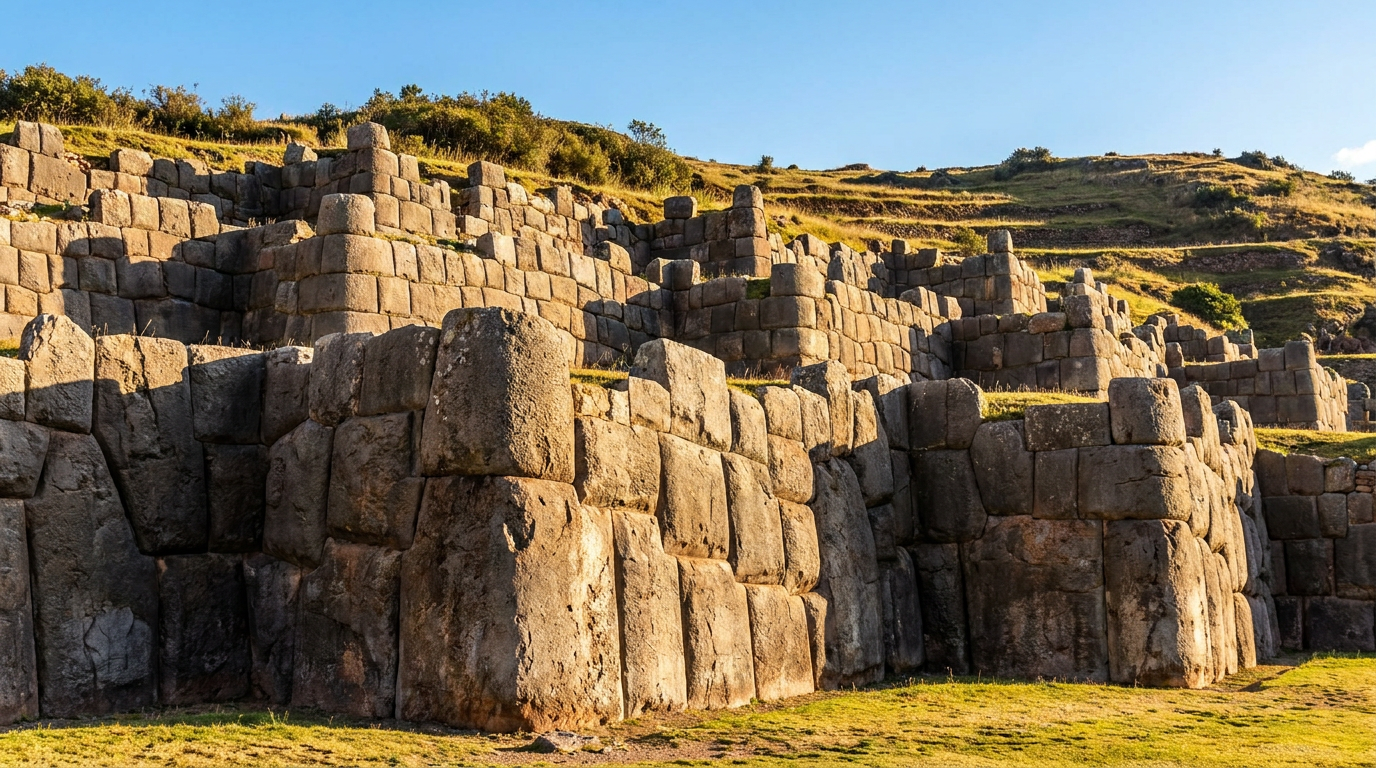
The Sacsayhuaman mystery comes down to one stubborn fact: the Inca fitted multi-ton limestone and andesite blocks into walls so tight you cannot slide a knife blade between them, without iron tools, wheels, or mortar. That precision still puzzles engineers who visit the site above Cusco today. Once you understand the pounding-stone method and the quarry evidence left behind, the “impossible” walls start to look like the product of patient, brutal labor rather than lost technology.
How the Inca Shaped Stone Without a Single Iron Chisel
Andean stoneworkers never had iron or steel. Their toolkit was harder rock: dense hammerstones made of hematite and river cobbles, swung by hand against softer limestone and andesite blocks.
Repeated pounding, not cutting, wore the stone down. Archaeologists have recovered these worn, rounded hammerstones scattered around the Sacsayhuaman quarries, exactly where the shaping happened. The same blunt-force approach shows up at other Andean sites, and it is a far cry from the metal-chisel myths that circulate online.
The Precision-Fit Joints That Make Sacsayhuaman Famous
The walls’ signature feature is polygonal masonry: irregular, multi-sided blocks locked together edge to edge with no gaps and no mortar. Builders likely test-fit each block repeatedly, grinding down high spots with sand and smaller stones until the surfaces mated almost perfectly.
One popular theory holds the interlocking shapes helped the walls flex and resettle during earthquakes, a real hazard in this part of the Andes. That earthquake-resistance idea is widely repeated but remains a hypothesis, not a confirmed engineering finding, since no Inca text explains the intent behind the design.
The same obsession with joint precision without mortar shows up at other ancient megalithic sites that defy modern tool assumptions, suggesting independent cultures converged on similar solutions rather than sharing one lost method.
Where the Stone Came From, and How It Got There
Much of Sacsayhuaman’s stone was quarried from sources near Cusco, including the Rumiqolqa area roughly 35 kilometers away, along with closer local outcrops for the largest blocks. Some individual blocks are commonly cited in the tens of tons, with a few estimates for the largest stones running much higher.
How crews moved blocks that size over hilly terrain is still debated. Ropes, log rollers, earthen ramps, and large labor crews are the leading explanations, but no confirmed Inca record describes the exact method, so treat any single “solved it” claim with skepticism.
The transport puzzle echoes debates around other massive stone monuments, including the Baalbek trilithon’s even heavier stones and the long-running arguments over how the pyramids were really built, where similarly ordinary methods, scaled up with enormous manpower, are the leading explanation over any exotic technology.
Why the Inca Never Needed Iron
The Inca worked bronze for tools and ornaments, but bronze is too soft to cut hard igneous rock efficiently. Iron and steel were unnecessary once builders leaned on abrasion, patience, and stone-on-stone force instead of a cutting edge.
That toolkit, hammerstones plus sand abrasives plus test-fitting, produced results that still look implausible today, which is exactly why Sacsayhuaman keeps drawing fringe theories despite the quarry evidence sitting in plain sight.
Frequently Asked Questions
Did the Inca have any metal tools at Sacsayhuaman? They worked bronze, but bronze is soft and mainly served ornamental or ceremonial purposes. Stone hammerstones did the heavy shaping work on the fortress walls.
How heavy is the largest stone at Sacsayhuaman? Estimates vary by source and are not independently verified with modern equipment, but several of the largest blocks are commonly cited in the range of many tens of tons, among the heaviest worked stones in the Americas.
Is the precision-fit masonry proof of lost ancient technology? No confirmed evidence supports that claim. The polygonal joints are best explained by slow, repetitive test-fitting and grinding, a documented technique with matching hammerstone tools found on site.