

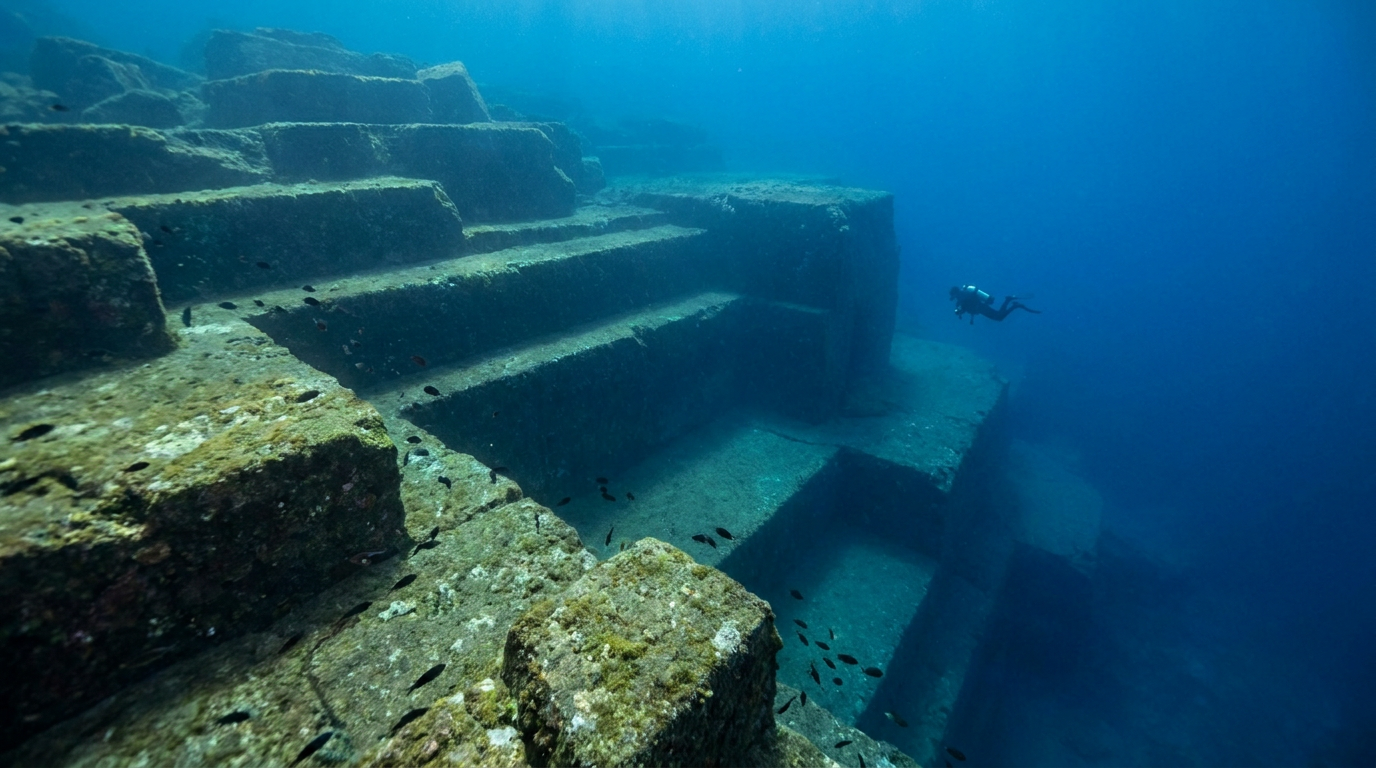
The Yonaguni Monument is most likely a natural sandstone formation shaped by fracturing and erosion, not a sunken city, though a vocal minority of researchers still argue parts of it were carved by human hands. The structure sits off Japan’s Yonaguni Island, its flat terraces and sharp angles looking eerily architectural underwater. Here’s what the rock strata actually show, and why marine geologists and one persistent archaeologist still disagree.
What Is the Yonaguni Monument?
The formation sits roughly 25 meters below the surface, discovered by a local diver in the mid-1980s. It stretches for dozens of meters in stepped terraces, flat platforms connected by staircase-like edges.
Photos alone have launched decades of debate. The stone reads like a stepped pyramid built for something.
The Geologist’s Case: Natural Sandstone Fracturing
Most geologists who have studied Yonaguni’s rock point to something unglamorous: sandstone here splits along bedding planes and joints. The rock is mudstone and sandstone laid down in horizontal layers roughly 20 million years ago, then lifted and cracked by tectonic stress.
Layered sandstone like this tends to fracture in straight lines and right angles naturally, the same way slate splits into flat sheets. Add wave action scouring softer layers away over thousands of years, and you get stepped terraces without a chisel mark.
Comparable terracing exists elsewhere along Japan’s coastline with zero connection to human activity, which weakens the case that Yonaguni’s shape requires an explanation beyond erosion.
The Archaeologist’s Case: Kimura’s Terraces and Steps Argument
Marine geologist Masaaki Kimura, who has dived the site over a hundred times, argues the opposite. He points to features he says erosion alone doesn’t explain: consistent step heights and what appear to be carved channels.
Kimura has proposed the site could be linked to a landmass submerged thousands of years ago, tied to sea level changes at the end of the last ice age. This remains a hypothesis, not an established finding, and it hasn’t gained traction among most geologists.
His strongest claim involves what he calls quarry marks and a carved facial feature nearby on land. Independent researchers who examined the same features generally attribute them to natural weathering patterns common in the local sandstone.
What Mainstream Science Actually Concludes
The dominant position, including Japanese university researchers who’ve published on the site, is that Yonaguni’s terraces formed through differential erosion along natural joint patterns. No confirmed tool marks, artifacts, or dating evidence for human construction have been widely accepted in the scientific literature.
Still, “most likely natural” isn’t “proven natural.” No comprehensive excavation has fully settled it, so some uncertainty remains part of the honest picture.
If you want the fuller sunken-city genre this case gets lumped into, the Atlantis location theories ranked by evidence follow the same pattern: dramatic visual, thin proof, endless argument.
Why the Debate Keeps Resurfacing
Yonaguni gets recycled in alternative-history content because it hits every trigger at once: underwater, ancient, geometric, unexplained. That’s the same pull that keeps Nan Madol’s coral reef city in constant rotation, a real structure with genuine mysteries still attached to how its builders moved and stacked the stone.
Yonaguni differs in one key way. Nan Madol is confirmed human-built. Yonaguni’s human origin is the exact thing still up for debate, which is why it hasn’t faded from the conversation the way settled sites like Baalbek’s trilithon stones have.
Frequently Asked Questions
Is the Yonaguni Monument definitely natural?
Most geologists lean toward natural sandstone fracturing as the likely explanation, but no fully conclusive study has closed the debate. Treat any absolute claim in either direction as overstated.
Who discovered the Yonaguni Monument?
A local dive tour operator spotted it in 1986 while scouting for hammerhead shark sightings near Yonaguni Island. Masaaki Kimura began studying it seriously soon after.
Can you dive to see the Yonaguni Monument yourself?
Yes. Local dive operators run regular trips to the site, and it sits shallow enough for most certified divers to explore the terraces directly, current permitting.