

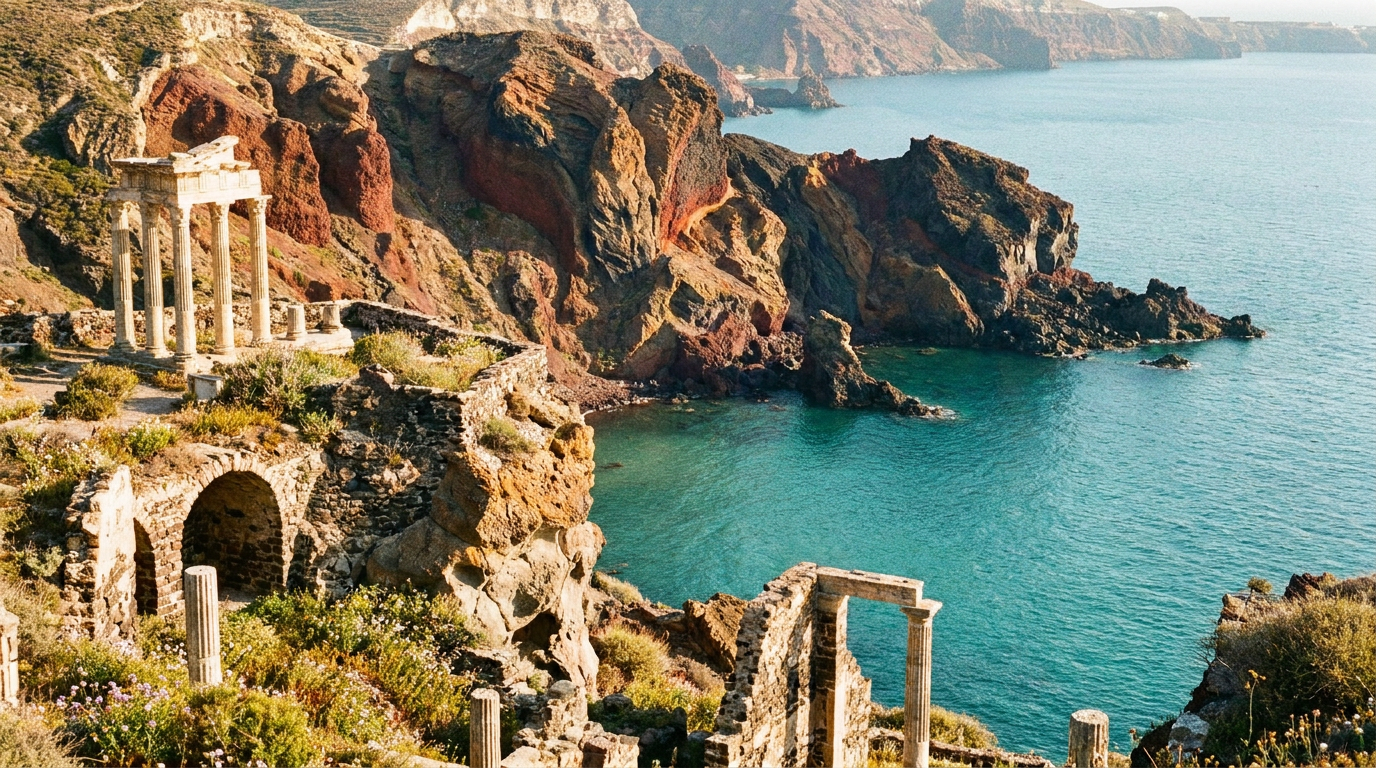
The strongest real-world candidate for the lost city of Atlantis is Santorini (ancient Thera), where a massive volcanic eruption around 1600 BCE buried a thriving Minoan settlement under ash almost overnight. Sardinia and the Azores also have vocal supporters. Only one of the three holds up against the archaeological and geological record.
Plato’s account, written around 360 BCE, describes an advanced island swallowed by the sea in one catastrophic event. Every modern theory tries to match a real place to that story. Here is how the three leading candidates stack up against actual evidence.
Santorini and the Minoan Eruption
The Thera eruption is one of the largest volcanic events of the ancient world, confirmed by ice-core and tephra layer dating. It collapsed the island’s center into a caldera, the same basin shape tourists photograph today.
Excavations at Akrotiri on Santorini uncovered multi-story buildings, indoor plumbing, and frescoes, evidence of a genuinely sophisticated Bronze Age society buried in ash. Archaeologists widely link this event to the collapse of Minoan influence across the Aegean.
The gap: Plato places Atlantis outside the “Pillars of Hercules,” meaning the Atlantic, not the Mediterranean. Supporters argue Plato or his sources scrambled the geography while keeping the disaster real. Plausible, not confirmed.
Sardinia’s Nuragic Ruins
Sardinia’s case rests on the nuraghi, thousands of Bronze Age stone tower-fortresses scattered across the island, plus recent sonar surveys claiming to show submerged structures off the coast.
The nuraghi are real and remarkable, proof of organized construction and metallurgy earlier than most people assume. That part of the theory has solid archaeological footing.
The submerged-structure claims are the weak link. No peer-reviewed excavation confirms the sonar anomalies as man-made, and geologists point to erosion patterns that mimic walls at low resolution. Until a dive team publishes hard data, this stays a hypothesis.
The Azores and Mid-Atlantic Ridge
The Azores theory leans on plate tectonics: the islands sit on the Mid-Atlantic Ridge, an active volcanic and seismic zone, which fits Plato’s sudden-catastrophe framing better than any Mediterranean site.
But the ridge only surfaces as islands. There is no seafloor mapping, no core sample, and no artifact that points to a sunken landmass large enough to match Plato’s description of an island “larger than Libya and Asia combined.”
Geologically, this theory borrows credibility from real tectonic activity while skipping the part that matters most: physical proof anyone lived there before it vanished.
Which Theory Actually Wins
Ranked by evidence quality, Santorini leads by a wide margin. It has excavated ruins, a dated cataclysm, and a documented civilizational collapse, the only candidate with all three.
Sardinia comes second on the strength of its confirmed land archaeology, even though its underwater claims remain unproven. The Azores rank last: real geology, zero archaeology.
None of the three closes the gap entirely, which is exactly why what Plato actually wrote about Atlantis still matters more than any single location pin. The text itself may blend memory, metaphor, and moral lesson rather than a literal travel log.
If you want the bigger construction-mystery picture these theories borrow from, the debate echoes claims made about megaliths that defy modern tools and the wider pattern of lost ancient high-tech claims, where evidence again separates the plausible from the popular.
Frequently Asked Questions
Is there physical proof Atlantis existed exactly as Plato described? No single site matches every detail of Plato’s account. Santorini matches the disaster and the sophistication; it does not match the Atlantic location Plato specified.
Why do so many locations claim to be Atlantis? Plato’s description is vivid but geographically loose, so any coastal region with a real catastrophe or impressive ruins becomes a candidate for writers looking for a hook.
Could Atlantis simply be a myth with no real location? Many historians treat it as a philosophical device Plato invented to illustrate hubris and downfall, not a place he expected readers to go find.