

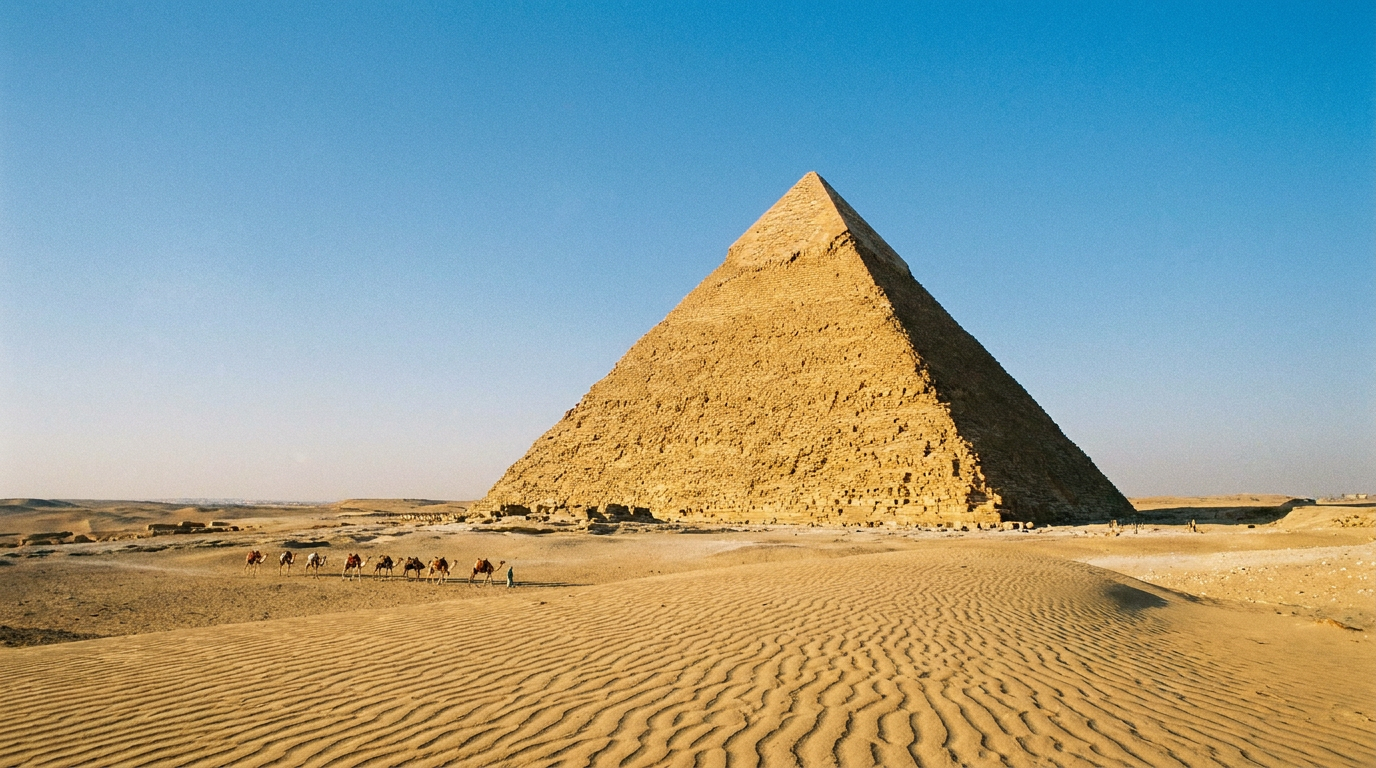
No construction plan for the Great Pyramid of Giza has ever been found, and there is a real reason for that: ancient Egyptian builders likely never wrote one down the way you might sketch blueprints for a house. The knowledge lived in the hands of master builders, passed through work crews, not stored on papyrus for later discovery. That absence has fueled a century of speculation, and it has pushed modern researchers to try something different: scanning the pyramid instead of hunting for a document.
You are looking at one of the most studied buildings on the planet, and archaeologists still cannot tell you exactly how the ramps worked or what several internal voids are for. The construction debate around the pyramids has never fully closed, and that is exactly why projects like ScanPyramids exist.
Why No Blueprint Survives
Egyptologists have found administrative papyri connected to pyramid construction, including logistics and labor records from sites like the Wadi al-Jarf harbor. What they have not found is a technical drawing showing angles, load calculations, or a build sequence for the Great Pyramid itself.
Papyrus degrades fast, and building know-how in ancient Egypt appears to have been an oral, practical craft, refined project by project rather than written into a master document. Smaller diagrams exist from other contexts, but nothing on the scale of a full pyramid plan has ever surfaced.
What ScanPyramids Actually Found
The ScanPyramids project, an international mission using muon tomography, has spent years imaging the interior of the Great Pyramid without drilling into a single stone. Muon detectors placed inside and around the structure track subatomic particles that pass through solid rock differently than they pass through empty space.
That method led to the widely reported discovery of a large void above the Grand Gallery, announced by the team in 2017. Researchers know a cavity exists there. What it was built for, whether structural relief, a chamber, or something else, remains unresolved. Treat this as confirmed detection, not confirmed purpose.
For the wider engineering picture, the broader story of ancient Egyptian architecture shows this is not an isolated mystery.
Where the “Missing Blueprint” Theories Go Wrong
Alternative history claims often jump from “no blueprint has been found” to “the true builders erased the evidence” or “the plan came from a lost advanced civilization.” Neither claim holds up against the archaeological record, which includes quarry marks, worker graffiti, and tool evidence consistent with Fourth Dynasty Egyptian methods.
The honest position sits in between. You do not need a lost civilization to explain missing paperwork, just a culture that built through apprenticeship and a climate that destroys organic records over millennia. Some readers still ask whether the structure predates its accepted timeline, a question examined directly in this look at the pyramid age debate.
What Remains Genuinely Unknown
Scholars still debate the exact ramp system used to move multi-ton blocks, since no single design fully explains every phase of construction. The purpose of the void above the Grand Gallery is unconfirmed. And how workers achieved such tight tolerances without modern surveying tools is still being reconstructed, not fully explained.
These are not signs of a cover-up. They are the normal gaps you get when a structure this old outlives every written record of how it was made.
Frequently Asked Questions
Did the ancient Egyptians leave any written plans for the Great Pyramid?
No confirmed architectural blueprint for the Great Pyramid has been discovered. Related administrative records exist, but a full technical plan has never been found.
What is the ScanPyramids project?
It is an international research mission that uses muon tomography and other non-invasive imaging to map the interior of Egyptian pyramids without drilling into them.
What did ScanPyramids discover inside the Great Pyramid?
The project detected a large previously unknown void above the Grand Gallery, announced in 2017. Its exact function is still undetermined.