

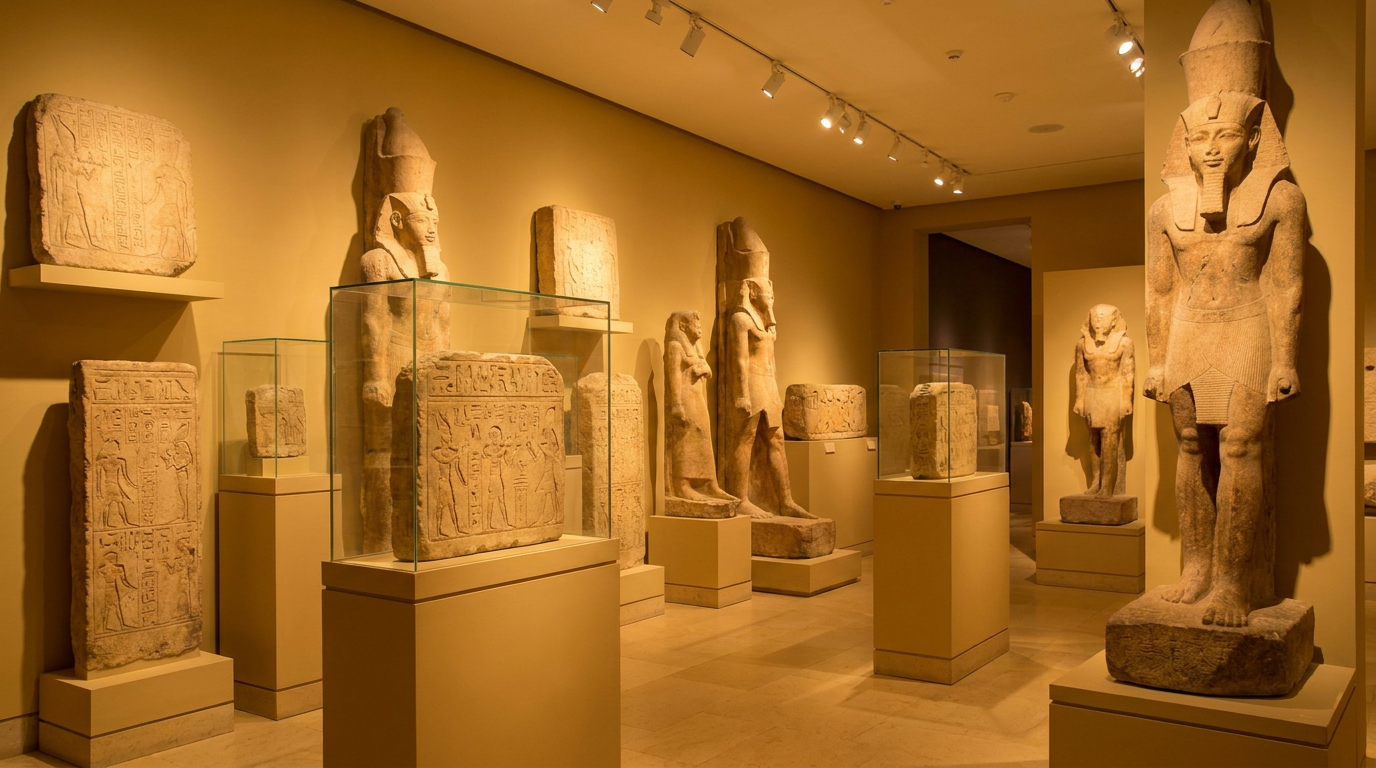
The Narmer Palette, the Rosetta Stone, and the Merneptah Stele are the ancient egypt artifacts that forced historians to redraw the timeline of Egyptian civilization. Each one reset a date, unlocked a language, or confirmed a name that written history alone could not settle.
You cannot read Egyptian history the same way once you know what these three objects proved. Here is what each one actually showed, and why archaeologists still treat them as turning points rather than curiosities.
The Narmer Palette and the first hard evidence of a unified Egypt
British archaeologist James Quibell found the Narmer Palette in 1897 and 1898 at Hierakonpolis, a site in southern Egypt that once served as an early royal center.
The carved slate shows a king named Narmer wearing the crown of Upper Egypt on one side and the crown of Lower Egypt on the other, smashing an enemy underfoot in one scene and inspecting captives in another.
Historians had long assumed Egypt formed gradually out of separate regional chiefdoms. This single object gave them a face and a name to attach to that unification, which is why textbooks still open Egyptian dynastic history with Narmer rather than a vague era of early kingdoms. The palette also reframed how scholars view the power structure that followed unification, since one ruler controlling both crowns changed who answered to whom.
The Rosetta Stone and the decree that unlocked hieroglyphs
French soldiers found the Rosetta Stone in 1799 near the town of Rosetta, in the Nile Delta, while rebuilding a fort during Napoleon’s Egyptian campaign.
The stone carries one decree written three times: in hieroglyphic script, in the everyday Egyptian demotic script, and in Greek. Scholars already knew Greek. That gave them a way in.
Jean-Francois Champollion cracked the hieroglyphic system in 1822, working from the stone alongside other bilingual texts. Before that breakthrough, every hieroglyph on every temple wall, tomb, and papyrus in Egypt was decorative noise to modern readers. After it, Egyptians could speak for themselves again, in their own words, about their own history, including the writing system that ranks among Egypt’s most lasting inventions.
The Merneptah Stele and the earliest outside mention of Israel
Archaeologist Flinders Petrie found the Merneptah Stele in 1896 inside the pharaoh Merneptah’s mortuary temple at Thebes. It dates to roughly 1208 BCE, near the end of the pharaoh’s reign.
Most of the stele celebrates a military campaign, standard content for royal inscriptions of that period. One line near the end is what matters to historians outside Egyptology: it names Israel among the defeated peoples, the earliest known reference to that name in any surviving record.
That single line gives biblical historians and Egyptologists a fixed point where two separate timelines touch. It does not confirm or deny any specific biblical event, but it proves the name existed in a specific place at a specific moment in the 19th Dynasty, which is more than any other source from that period offers. Other finds, like the canopic jars used in Egyptian burial practice, show historians how ordinary belief worked day to day. The Merneptah Stele shows how Egypt’s rulers viewed the world beyond its borders.
Frequently asked questions
What is the most important ancient Egypt artifact ever found?
Many Egyptologists would point to the Rosetta Stone, since it made it possible to read almost every other Egyptian artifact and inscription directly, rather than through secondhand Greek and Roman accounts.
Where is the Narmer Palette kept today?
The Narmer Palette is held at the Egyptian Museum in Cairo, where it remains one of the earliest surviving records naming a specific Egyptian king.
Why does the Merneptah Stele matter outside Egyptology?
It contains the earliest known written reference to Israel, giving historians a rare fixed point where Egyptian records and biblical-era history can be checked against each other.