

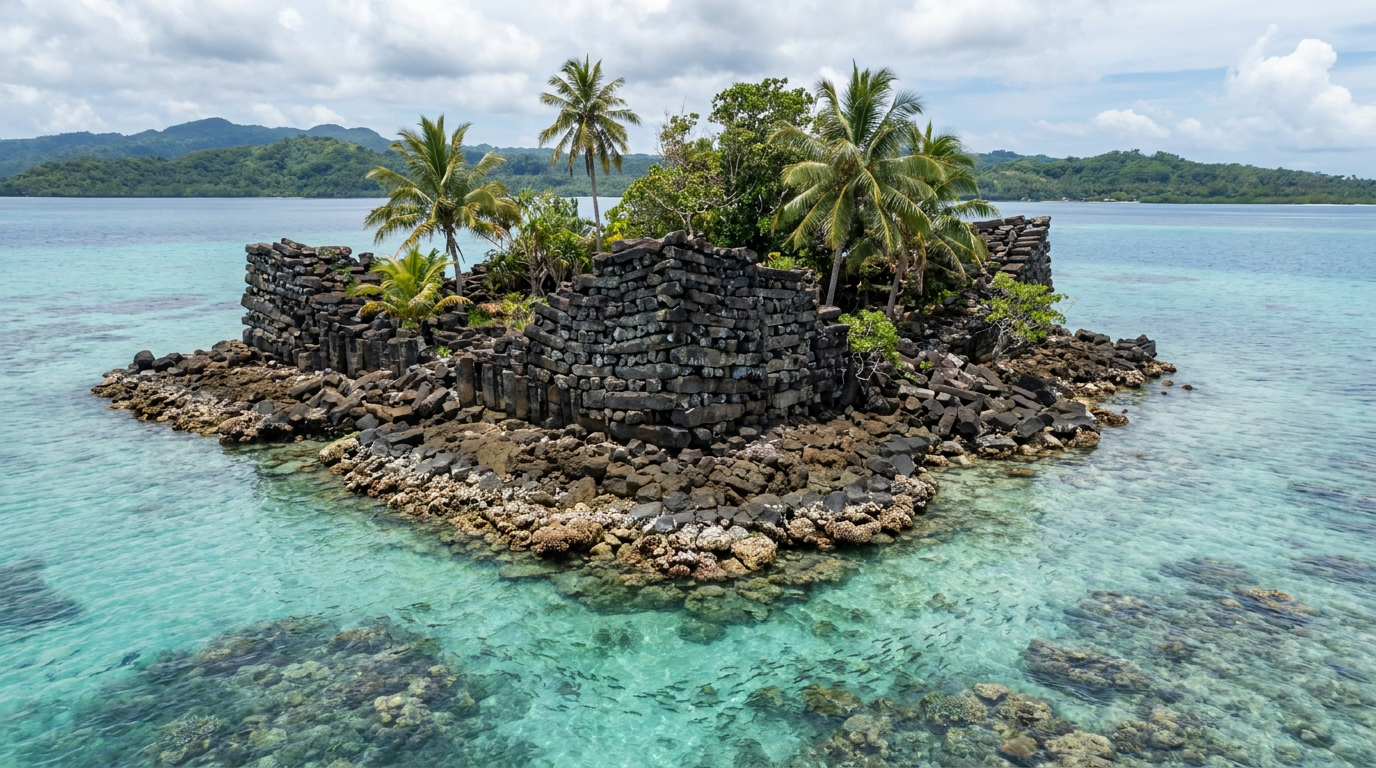
Nan Madol is a ruined city of nearly 100 artificial islets built from stacked basalt columns on a coral reef off Pohnpei, Micronesia. The Saudeleur dynasty raised it as their capital roughly between 1200 and 1500 CE. What makes it strange is not the age. It is the material: massive basalt columns, some in the multi-ton range, stacked on a reef flat with no confirmed quarry nearby.
You are looking at a city mainstream archaeology accepts as historically real, built by a documented Pacific dynasty, using a transport method nobody has fully reconstructed. That combination is rare.
By the end you will know who built Nan Madol, what the columns are, and why the transport question stays open rather than solved.
What Is Nan Madol and Where Is It Located
Nan Madol sits off southeastern Pohnpei, part of the Federated States of Micronesia. The site covers close to 100 small artificial islets separated by tidal canals, earning it the nickname “Venice of the Pacific.”
Builders raised each islet on coral rubble fill, then walled and terraced it with columnar basalt. The largest structure, Nandauwas, held royal tombs behind retaining walls several meters high. UNESCO listed Nan Madol as a World Heritage Site in 2016, citing both its scale and its exposure to storms and rising seas.
Who Built Nan Madol: The Saudeleur Dynasty
Pohnpeian oral tradition and early ethnographic accounts credit the Saudeleur dynasty as builders and rulers of Nan Madol. The Saudeleurs centralized power over the island from this capital for centuries before local tradition remembers their rule ending in overthrow.
That is a real distinction from other megaliths that defy modern tools. Nan Madol is not an orphan structure. You have a named dynasty, an oral history, and archaeological layers supporting centuries of continuous building.
The Basalt Columns: Where Did the Stone Come From
The material is columnar basalt, volcanic rock that naturally fractures into long, roughly hexagonal pillars as lava cools. Builders stacked these logs in alternating crisscross layers, forming retaining walls with no mortar.
Basalt itself is not exotic to Pohnpei’s volcanic geology. What stays unresolved is which specific quarry supplied the volume used across the whole site. Researchers have floated several candidate sources on the island, but none has been definitively matched to the full scale of construction.
How Were the Columns Moved to a Reef With No Nearby Quarry
This is the part nobody can fully explain. Moving multi-ton columns across water, then stacking them to survive roughly 700 years of storms, needed methods that left little physical trace.
Proposed explanations include rafts towed through tidal channels at high water, log rollers on temporary causeways, and relay transport across generations. None is confirmed. Treat this as an open question, not a solved one, the same honest gap you see at Baalbek’s trilithon stones, where blocks weighing hundreds of tons were moved by methods still debated.
Why Nan Madol Is a Different Kind of Mystery Than Giza
Egyptologists have quarry marks, worker villages, and ramps to build theories from, even with real debate over methods, as covered in how the pyramids were really built. Nan Madol has far less supporting evidence: fewer records and a reef environment that erases traces faster than desert sand.
That evidence gap, not a lack of scholarly effort, is why transport stays an open question.
Frequently Asked Questions About Nan Madol
Is Nan Madol older than the pyramids?
No. The pyramids date to roughly 2600 BCE, while Nan Madol’s main construction phase falls around 1200 to 1500 CE, making it far younger.
Can you visit Nan Madol today?
Yes, Nan Madol is accessible on Pohnpei with a local guide, though many islets are overgrown and some canals require a boat.
Why is Nan Madol called the Venice of the Pacific?
The nickname comes from its layout: nearly 100 artificial islets divided by tidal canals, similar to how Venice sits on canals and islands.