

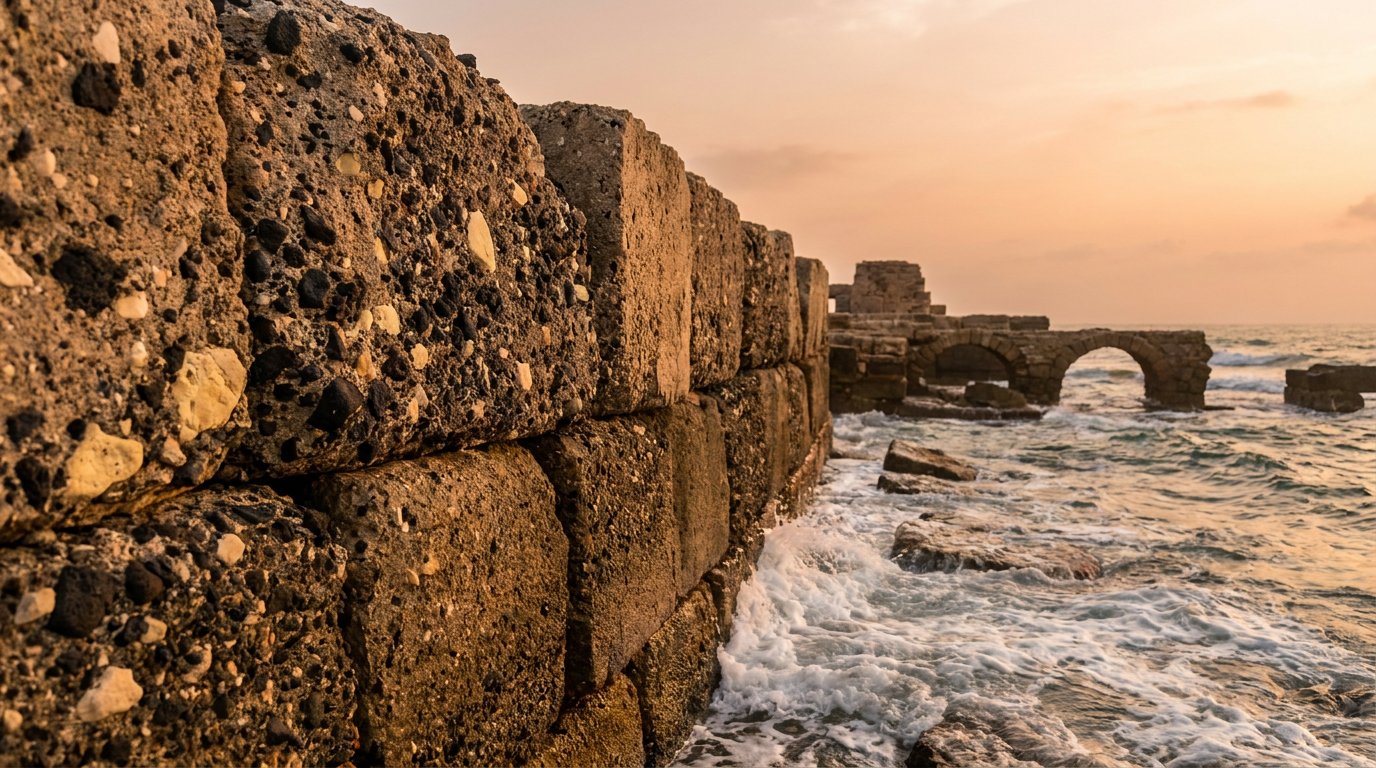
Roman concrete self healing works because Roman builders mixed in lumps of quicklime that never fully dissolved. When a crack opens near one of these lime clasts, water gets in, reacts with the leftover lime, and the reaction product fills the gap before the crack can spread.
You have probably heard that Roman concrete lasts two thousand years while modern sidewalks crumble in decades. That comparison sounds unfair once you know what each material was built to do, and the real chemistry is more interesting than the myth anyway.
This piece walks through the 2023 MIT-led findings on lime clasts, the separate seawater chemistry the Romans used at their harbors, and why “the Romans were just better” misses the point.
What Are Lime Clasts and How Do They Heal Cracks
Lime clasts are small white chunks of unreacted lime scattered through ancient Roman concrete. For decades, researchers assumed these lumps were a sign of sloppy mixing.
A 2023 study led by researchers at MIT proposed a different explanation. The Romans used hot mixing, combining quicklime directly with volcanic ash and water at high heat rather than pre-slaking the lime first, leaving reactive clasts behind on purpose.
When a crack reaches one of these clasts, water seeping through the fracture dissolves calcium from it. That calcium-rich solution recrystallizes inside the crack, sealing it before it widens. It will not stop every crack from forming, but it gives the material a repair pathway ordinary Portland cement never had.
Why Roman Seawalls Have Survived Centuries in the Ocean
Roman harbor concrete faced a separate challenge: constant seawater exposure. For structures like breakwaters and piers, builders used pozzolana, volcanic ash sourced from around Pozzuoli near the Bay of Naples, mixed with lime and seawater.
Over time, that seawater interacts with the volcanic ash to grow new mineral phases inside the concrete, including calcium-aluminum-silicate-hydrate (C-A-S-H) and a rare mineral called aluminous tobermorite. These minerals actually strengthen the concrete as it ages in salt water, rather than corroding it.
That is the opposite of what happens to modern reinforced concrete near the ocean, where saltwater intrusion attacks steel rebar and cracks the structure from the inside out.
Was Roman Concrete Simply Better Than Modern Concrete
Not exactly, and framing it that way misunderstands what each material was engineered for. Roman concrete had no steel reinforcement, so it never had to manage rebar corrosion, one of the biggest long-term threats to modern structures.
Modern concrete is designed around fast curing times, high compressive strength for skyscrapers and bridges, and cost efficiency at massive scale. Roman builders had none of those pressures and centuries to let a harbor wall sit.
Different goals produced different materials. Comparing a Roman seawall to a modern parking garage compares two answers to two different questions.
What This Means for Concrete Today
Materials scientists studying the lime clast mechanism have started testing self healing additives inspired by hot mixing. None of that work has replaced standard construction concrete yet.
The bigger lesson sits close to how the pyramids were really built, or how the builders behind Baalbek’s trilithon stones solved problems without modern tools. Ancient engineers worked within real material limits, the same way the stonework at Sacsayhuaman answers a different set of constraints.
Frequently Asked Questions
Does Roman concrete really heal its own cracks?
Yes, within limits. Lime clasts left over from hot mixing react with water entering a crack and recrystallize inside the gap, sealing small fractures before they spread further.
Why do Roman seawalls survive better than modern concrete in water?
Roman harbor concrete used volcanic ash that reacts with seawater over time to grow strengthening minerals. Modern reinforced concrete instead suffers when saltwater corrodes its internal steel rebar.
Is modern concrete inferior to Roman concrete?
Not in a simple sense. Modern concrete is built for speed, cost, and compressive strength with steel reinforcement, goals Roman builders never had to balance against seawater durability over centuries.