

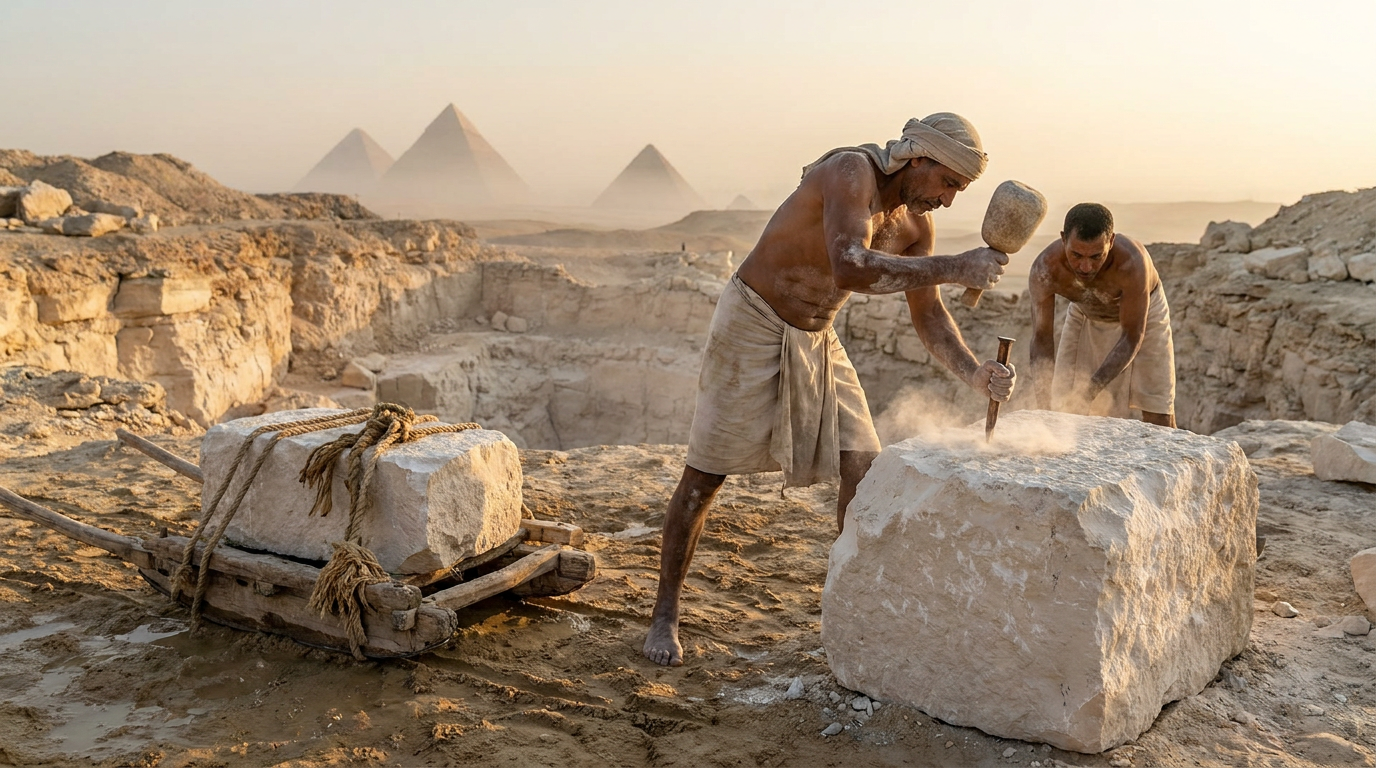
Egyptians built without iron tools or a wheel for heavy loads by matching the tool to the stone: copper chisels for soft limestone, harder pounding stones for granite, wooden sledges dragged over wetted sand instead of wheeled carts, and levers to finish the small final movements.
None of that requires a lost technology. It requires knowing exactly which low-tech method survives contact with a multi-ton block, and replication tests keep confirming the same combinations work.
Here is what the tools and the experiments built to test them actually show.
What Cutting Tools Egyptians Had Without Iron
Iron use in Egypt came long after the pyramid age, so builders worked almost entirely in copper and stone. Copper chisels cut limestone well enough, but the edge is soft and rounds off fast against anything harder.
For granite and other dense stone, crews turned to pounding stones made of dolerite, a rock harder than the target material. Dolerite pounders battered and abraded the surface rather than slicing it, a slower method that never depended on holding a metal edge.
Wear-testing on replica copper tools shows how quickly that edge degrades against stone, which lines up with the sheer volume of discarded copper tools found near ancient quarry sites. Crews were not cutting with a handful of chisels. They were burning through them constantly.
Why Wetted Sand Made Sledges Work Without a Wheel
A wheel only helps on a hard, flat surface with an axle that can carry serious weight. Loose desert sand offers neither, which is likely why wheeled carts never became the answer for heavy loads at Giza.
Instead, workers hauled blocks on wooden sledges. A tomb painting from Deir el-Bersha shows a large statue being dragged on a sledge while a worker pours liquid onto the sand just ahead of the runners.
Small-scale friction experiments built around that image found that wetting sand to the right consistency measurably cuts drag on a sledge, likely by stiffening loose grains enough to stop them piling up under the runners. Too dry and the sand behaves normally. Too wet and it turns to drag-heavy mud.
How Levers Handled What Sledges and Ramps Could Not
Ramps did the vertical lifting, whether built as one long incline, a zigzag, or something spiraling around the structure as it rose, a question the wider debate over how the pyramids were really built covers in more detail.
Levers filled the gaps ramps and sledges left open: prying a block the final centimeters into place, or rocking one edge up onto a wooden cradle at a time. Later Greek writers described lever-and-fulcrum work as ordinary engineering knowledge, and there is no strong reason to assume Egyptian crews lacked the same basic principle generations earlier.
What Other No-Iron, No-Wheel Sites Confirm
Egypt was not alone in solving this problem with local materials. At Sacsayhuaman, Inca masons cut and fitted massive stone walls using hammerstones instead of metal, relying on abrasion and patience over a sharp edge.
At Baalbek, movers of the trilithon’s enormous blocks appear to have leaned on ramps, levers, and large coordinated crews rather than any single mechanical shortcut, the same pattern the physical evidence at Giza points toward. Different regions, same answer: organized labor solving a materials problem, not a missing technology.
Frequently Asked Questions
Did ancient Egyptians know about the wheel at all?
Yes. Wheeled vehicles existed in the wider region, but a cart wheel could not carry multi-ton blocks over loose sand, so builders relied on sledges instead.
How did soft copper tools cut hard granite?
Mostly they did not. Granite was shaped with harder dolerite pounders that battered the surface, while copper tools were reserved for softer limestone.
Does the wetted-sand trick actually reduce friction?
Small-scale experiments modeled on Egyptian tomb art found that the right amount of moisture measurably reduces sledge drag, though scaling that result to full-size blocks is still debated.