

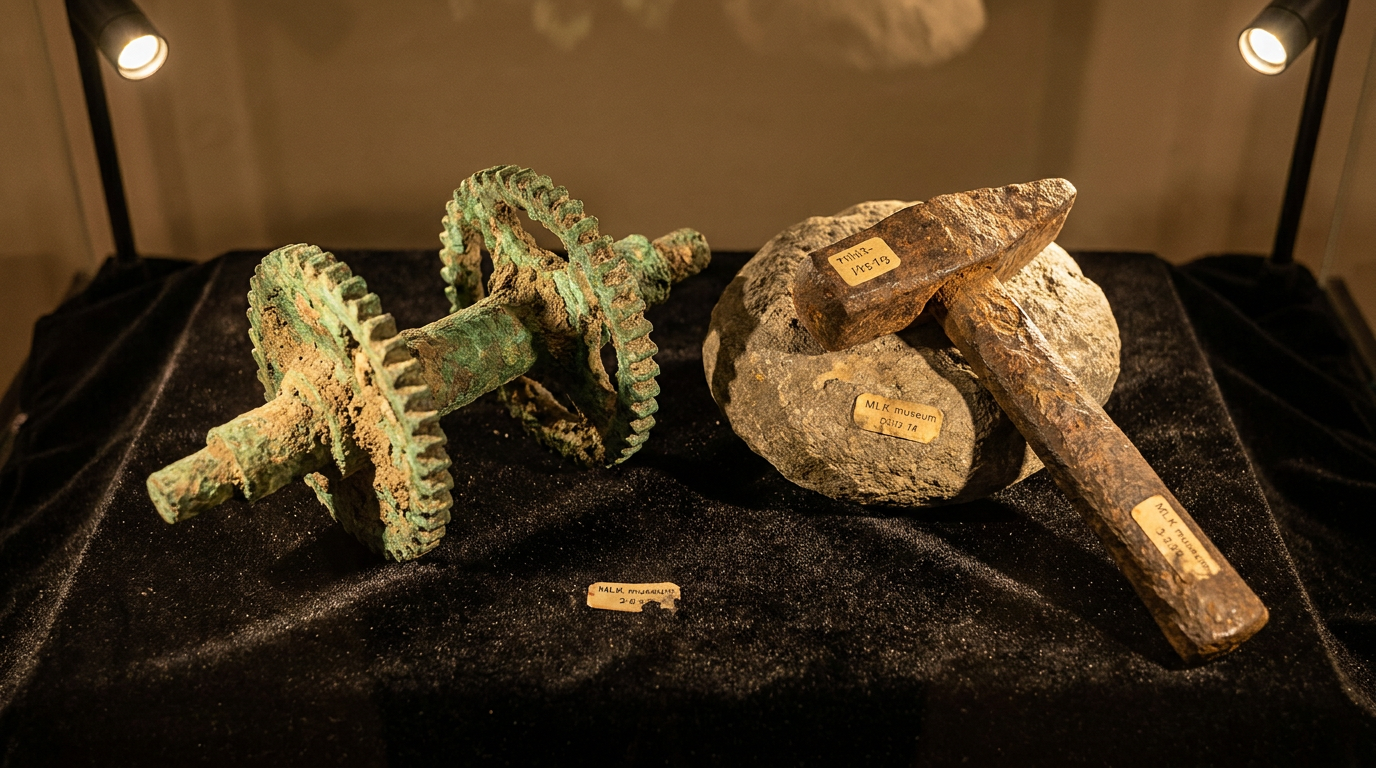
Most “out of place artifacts” are not evidence of a lost advanced civilization. They are ordinary objects that geology, mineral chemistry, or plain misreading of the historical record dressed up as impossible.
The London Hammer and the Antikythera mechanism get cited together constantly in alt-history videos, but they belong to two completely different categories of claim.
One is a rock formation with a mundane explanation. The other is a real, dated Greek device that was never mysterious to begin with, only underestimated.
What People Mean by “Out of Place Artifact”
An out-of-place artifact, or OOPArt, is any object that supposedly does not fit the technology level of the era it was found in. The term covers everything from oddly shaped rocks to genuine archaeological finds that got exaggerated in retelling.
The pattern repeats across most of these claims. Someone spots an object that looks advanced, skips the boring explanation, and jumps straight to lost civilizations or ancient visitors. You can see the same pattern play out in other out-of-place artifacts often framed as unexplainable, most of which have documented, if less exciting, origins.
The London Hammer: A Concretion, Not a Mystery
The so-called London Hammer was found near London, Texas, embedded in a rock nodule along Red Creek. The claim is that the surrounding stone is old enough to make an iron hammer impossible.
Geologists who have examined it point to a much simpler process: concretion. Groundwater rich in minerals can cement sediment around an object relatively quickly, sometimes within decades rather than eons. The hammer itself matches a style of tool common in 19th century mining and blacksmithing, nothing older.
The rock around it tells you how the sediment hardened, not how old the metal handle inside is. That distinction gets lost every time this story circulates online.
Why the Antikythera Mechanism Is the Opposite Case
The Antikythera mechanism is a genuine Hellenistic-era bronze device, recovered from a shipwreck near the Greek island of Antikythera. Researchers date it to roughly the last two centuries BCE, placing it firmly within a well-documented period of Greek astronomy and mechanical craft.
Unlike the hammer, there is nothing mysterious about its origin. What surprised historians was the sophistication of its gearing, used to track lunar cycles, eclipse patterns, and the timing of Panhellenic games.
Ancient Greek writers described astronomical calculating devices long before this one turned up, so the mechanism confirms an existing tradition rather than rewriting history. Calling it “out of place” misreads what the evidence actually shows: consistent, advancing craftsmanship, not a technological anomaly.
You can trace that same pattern of underestimated ancient engineering in claims around megaliths that supposedly defy modern tools and in the ongoing debate over how the pyramids were actually built, where the real answer usually involves more labor and ingenuity than mystery.
Other Artifacts Lumped Into the Same Story
The Baghdad Battery and the Ica Stones get cited alongside the hammer and the mechanism, but they rest on weaker evidence and disputed dating. None require abandoning the standard timeline once you separate the object from the claim built around it.
The spread has less to do with archaeology and more with how retelling works online, a pattern covered in why conspiracy theories spread in archaeology.
Frequently Asked Questions
Is the London Hammer really millions of years old?
No. The rock nodule formed around the tool through mineral concretion, a process that can happen in decades. The hammer itself matches 19th century designs.
Is the Antikythera mechanism considered an out-of-place artifact?
Not by researchers who study it. It fits within known Hellenistic astronomy and mechanics, dated to roughly the last two centuries BCE, and confirms writings about earlier calculating devices.
Why do out-of-place artifact claims keep spreading?
Simplified retellings skip the geological or historical explanation because the mystery version is more shareable, not because the mundane explanation is missing.