

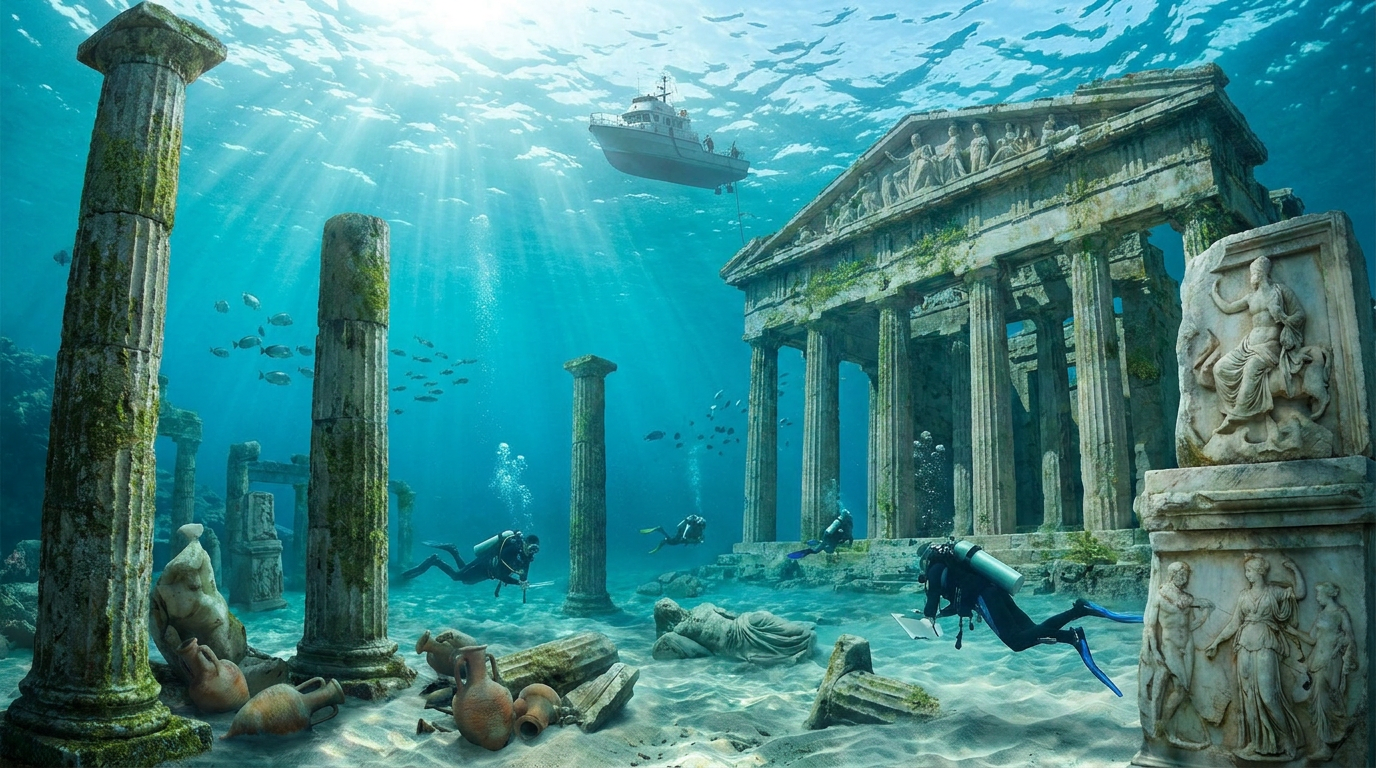
No archaeological find has ever confirmed a lost city of Atlantis. What actually exists is a single source: two dialogues written by Plato around 360 BCE, describing an island empire that sank beneath the sea in a day and a night. Everything else, the exact coordinates, the crystal technology, the psychic prophecies, was bolted on centuries later by people who were not reading Plato as a philosopher.
What Plato Actually Wrote in Timaeus and Critias
The Atlantis story appears in exactly two places in the ancient record: Timaeus and Critias. Plato frames it as a tale passed down from Solon, the Athenian lawmaker, who supposedly heard it from Egyptian priests during a visit to Sais.
In this account, Atlantis sits beyond the “Pillars of Hercules,” the ancient name for the Strait of Gibraltar. It is a ringed island of concentric land and water, ruled by descendants of Poseidon, wealthy beyond measure, and eventually corrupted by that wealth. The gods punish its hubris with earthquakes and floods, and the island vanishes in a single night.
Critias breaks off mid-sentence, unfinished. Plato never returned to complete it, and no other Greek writer of his era treats Atlantis as a real place.
Why Plato Told the Story in the First Place
Timaeus and Critias are not travelogues. They are philosophical dialogues built to illustrate an argument Plato makes elsewhere, most directly in the Republic, about the ideal state and what corrupts it.
Atlantis functions as the cautionary counterpart to Plato’s idealized ancient Athens: a rival power that starts virtuous, grows arrogant on its own prosperity, and gets destroyed for it. Classical scholars have long read this as political allegory dressed as history.
Where the “Real Atlantis” Additions Came From
The idea that Atlantis was literal, verifiable history did not come from antiquity. It came largely from Ignatius Donnelly’s 1882 book Atlantis: The Antediluvian World, which reinterpreted Plato’s allegory as a lost technological civilization.
Theosophist writers like Helena Blavatsky folded Atlantis into occult cosmology soon after, adding root races and lost sciences absent from Plato’s text. Later, self-styled psychic Edgar Cayce added prophecy readings claiming Atlantis would resurface, a claim some tried to connect to the underwater rock formation known as the Bimini Road. None of it traces back to the original dialogues.
What Mainstream Archaeology Actually Points To
Most historians who take the myth seriously as inspired-by-something look toward the Bronze Age eruption of Thera, the volcanic island now known as Santorini. That eruption devastated the Minoan civilization on nearby Crete and is the leading candidate for a real event filtered through centuries of retelling before reaching Plato.
That is a theory about inspiration, not confirmation. No submerged city matching Plato’s rings of land and water has ever been located. The myths around Atlantis, Mu, and Agartha share this same pattern: a kernel of ancient text, then generations of unrelated additions treated as if they belonged to the source.
So Is Atlantis Real?
As Plato wrote it, Atlantis is a philosophical device, not a place with coordinates. As later writers rebuilt it, it became a canvas for whatever theory needed an ancient, advanced civilization to make its point. That pattern repeats across lost civilizations once considered myths, and explains why conspiracy theories spread so easily in archaeology: a fragment of real evidence gets stretched past what it supports.
Frequently Asked Questions
Did Plato believe Atlantis was real?
Scholars disagree, but most read Timaeus and Critias as a constructed allegory built to make a political point, not a historical claim Plato expected readers to verify.
Has anyone found physical evidence of Atlantis?
No confirmed archaeological site matches Plato’s description of a ringed island civilization. Proposed sites, including Santorini and locations in the Atlantic, remain speculative.
Where did the idea of Atlantis as a lost advanced civilization come from?
Mostly from nineteenth and twentieth century writers, starting with Ignatius Donnelly in 1882, followed by Theosophist and psychic sources that added details absent from Plato’s original text.