

Most people overestimate how much solar they need and underestimate how much battery storage they need. Get that backwards and you end up with a $2,000 system that leaves you powerless by 9 PM. Here is what actually goes into a functional off-grid solar system for a van or RV, and the math to size it correctly before you buy a single panel.
The Four Parts of Every Off-Grid Solar System
Every setup, budget or premium, runs on the same four components. Swapping one out changes the whole equation.
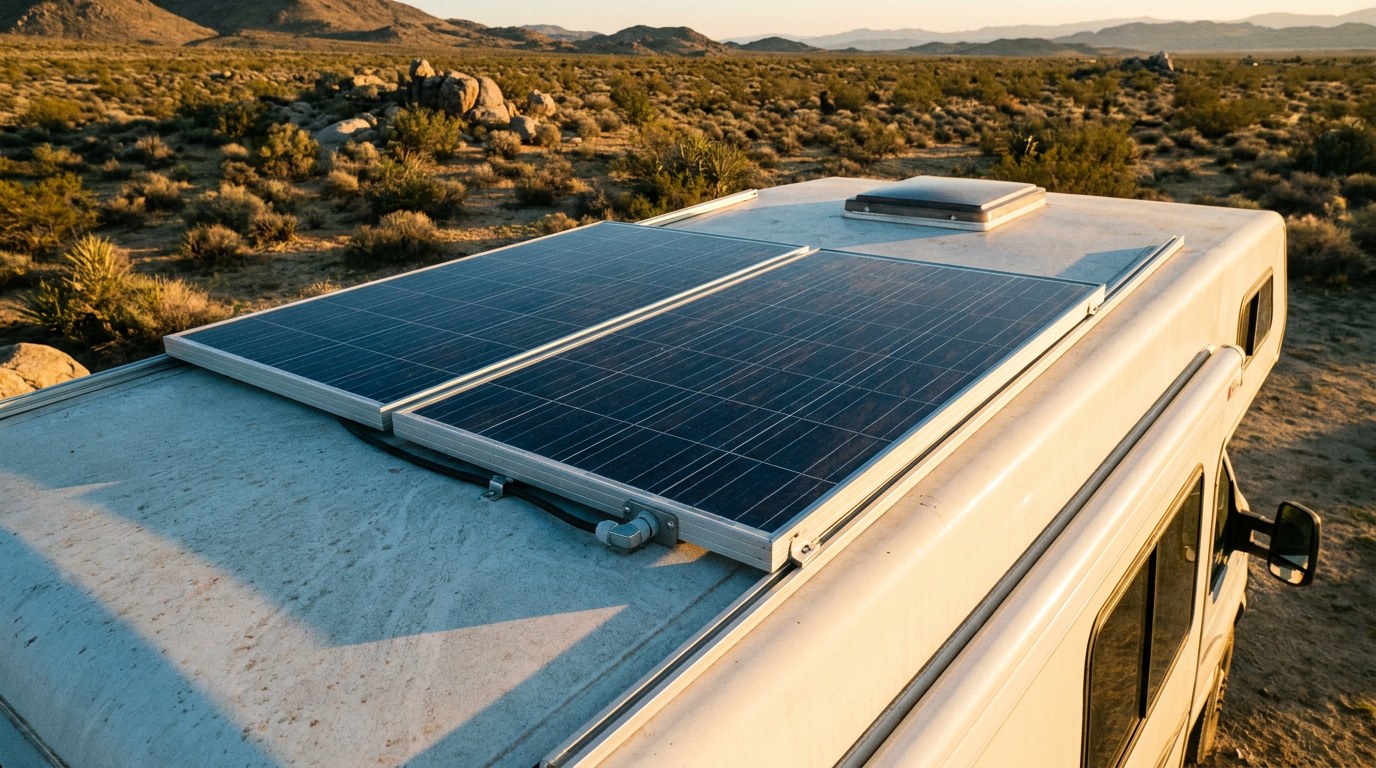
Solar panels convert sunlight into DC electricity. A standard 100W panel in full sun produces roughly 5-6 amp-hours per hour. Expect 4-5 peak sun hours per day in most of the US, less in the Pacific Northwest, more in the desert Southwest.
Charge controllers sit between the panels and the battery. PWM is cheaper and fine for small setups. MPPT costs more but squeezes 20-30% more efficiency from the same panels. On a build with 200W or more, MPPT pays for itself fast.
Batteries store what you collect. The dominant choice today is LiFePO4 (lithium iron phosphate): 80-100% usable capacity versus 50% for lead-acid, and 2,000-4,000+ cycles. Quality 100Ah units run $600-$1,200. Lead-acid is cheaper upfront and dies faster under daily cycling.
Inverters convert DC battery power to 120V AC. A pure sine wave inverter is the only real option for sensitive electronics. Modified sine wave causes humming, heat, and long-term damage to some devices.
How to Size a System Without Guessing
Start with a daily load calculation. List every device, its wattage, and hours of use. A 65W laptop for 4 hours is 260Wh. A 12V fridge running 24 hours draws 300-400Wh depending on insulation. Add everything up.
Say your total is 800Wh per day. Add a 20-25% buffer for wiring and controller losses and you are targeting roughly 1,000Wh of daily harvest.
With 4 peak sun hours, you need 250W of panels (1,000Wh / 4 hours = 250W). Most full-time van dwellers run 200-400W on the roof. If you work remotely, check how portable WiFi, eSIM, and local SIM cards affect your power budget before finalizing your inverter load.
For battery sizing, target enough capacity for 1-2 sunless days. A 200Ah LiFePO4 bank gives roughly 2 days of autonomy at 80% depth of discharge: 200Ah x 12.8V x 0.8 = 2,048Wh usable.
Wiring, Safety, and What People Skip
Wire every component with the correct gauge for the amps and run length. Undersized wire creates resistance, heat, and fires. Use a wire gauge calculator. It takes five minutes and prevents the leading cause of van fire.
A battery monitor (the Victron BMV series is the industry standard) shows exactly how much charge you have and how fast you are burning it. A $60-100 add-on that removes all the guesswork.
Fuse every connection between components. A midpoint fuse between the battery and inverter protects the cable from a short. Most kit buyers skip this entirely.
Realistic Budget Ranges
A 200W panel / 100Ah LiFePO4 / MPPT system built from components typically runs $900-$1,600. Plug-and-play kits from Renogy, EcoFlow, or Jackery cost more but require no wiring knowledge. A full 400W / 200Ah build for full-time remote work lands in the $1,800-$3,500 range for components alone.
Van life involves more trade-offs than just power. Whether a van beats coliving, renting, or housesitting on cost is worth sorting before you commit to a build.
For extended trips, small comfort gear matters more than people expect. A good camping pillow is the kind of item you ignore until three nights of bad sleep in a $4,000 build change your mind.
Frequently Asked Questions
How many solar panels do I need for a van?
For most builds without air conditioning, 200-400 watts covers daily loads of 600-1,200Wh. Your exact number depends on power consumption, location, and how many cloudy days your battery bank needs to cover.
Is LiFePO4 worth the cost over lead-acid for van solar?
Yes, for full-time use. LiFePO4 gives 80-100% usable capacity versus 50% for lead-acid, weighs roughly half as much, and lasts 4-10x longer under daily cycling. Over a 3-5 year build it almost always costs less.
What size inverter do I need for a van solar system?
Size your pure sine wave inverter to handle your largest single AC load with 20% headroom. A 1,000W unit covers most laptops, small appliances, and CPAP machines. For a microwave or power tools, step up to 2,000W.