

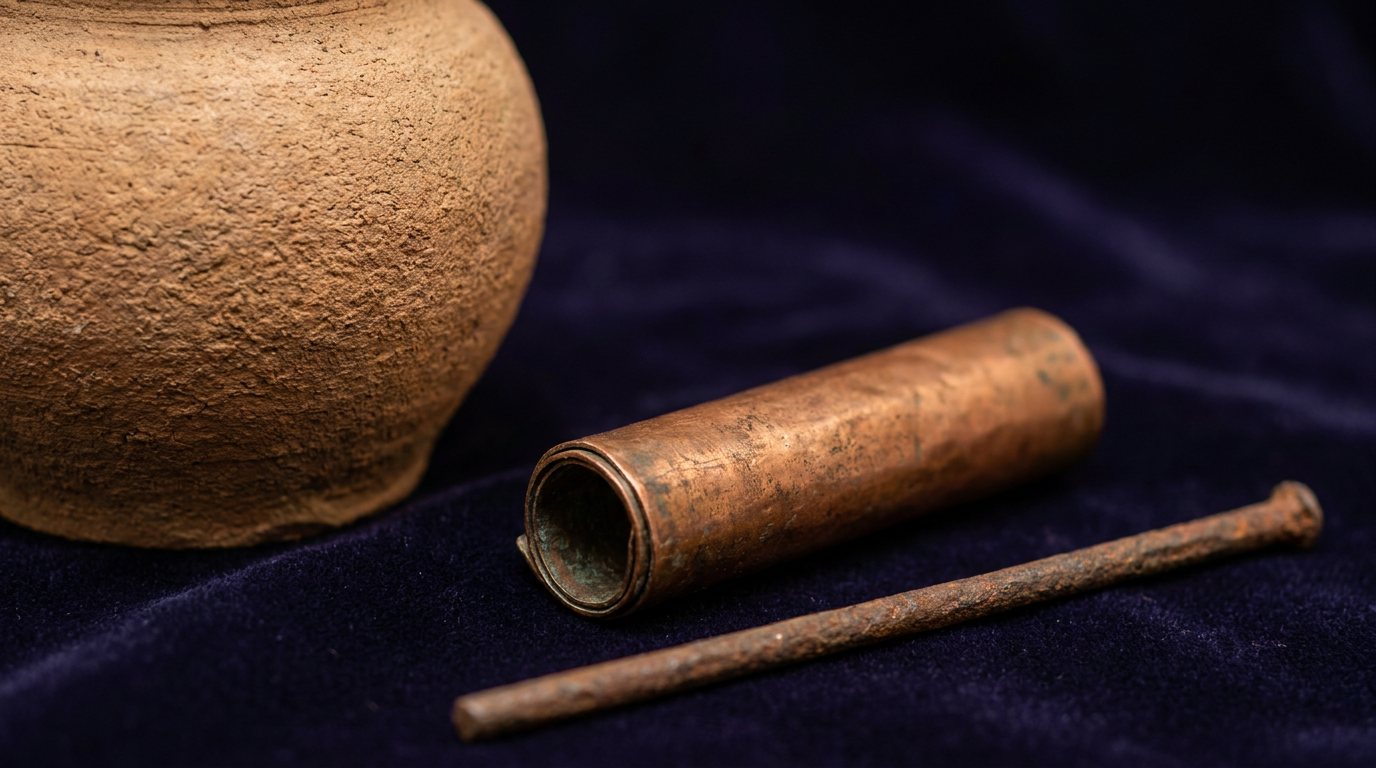
The Baghdad Battery is real as an object and fake as a battery. The jars exist, they sit in museum storage, and nobody disputes what they are made of. What is fake, or at least unsupported, is the idea that Parthian or Sasanian craftsmen built them to generate electricity on purpose.
You have probably seen the claim on a documentary or a “forbidden history” clip: ancient Iraqis wired up jars and used them to power something. Here is what the evidence actually says, and where the story quietly falls apart.
What Wilhelm Konig Found Near Ctesiphon
The objects came from the area around Ctesiphon and Khujut Rabu, south of modern Baghdad. In the 1930s, Wilhelm Konig of the Baghdad Museum examined a set of ceramic jars and reported something unusual inside one of them.
Each jar held a rolled copper cylinder with an iron rod suspended in the center, capped with asphalt sealant. The jars are dated to the Parthian or Sasanian period.
How the Battery Story Started
Konig noticed the copper-and-iron arrangement resembled a crude galvanic cell, the kind you would build in a chemistry class with two metals and an electrolyte. He floated the idea that the jars were ancient batteries, and the theory outran anything the excavation itself supported.
No wires were found with the jars. No conductors, no light bulbs, no plating apparatus, nothing that would connect a “battery” to any device. Ancient texts from Mesopotamia and Persia describe metalwork, medicine, and religion in detail. None mention electricity or electroplating.
What Replica Tests With Vinegar Actually Show
Later experimenters, including a few television productions, built replicas using the same copper cylinder and iron rod layout. Filled with an acidic liquid such as vinegar or grape juice, the setup produced a small voltage, the kind you would expect from any two dissimilar metals in an acid.
That result proves the shape can work as a crude cell. It does not prove the ancient jars ever held vinegar, or that anyone in Ctesiphon intended them to conduct current.
Why Archaeologists Read These as Storage Jars
The mainstream reading treats the copper-and-iron assembly as a container for scrolls or small relics, not a power cell. Rolled metal sheets were a known way to protect papyrus or parchment from moisture, and the iron rod held the roll rigid inside the copper sleeve.
That explanation fits the physical evidence: the jar shape, the sealing method, the absence of wiring, and the absence of electrical vocabulary in the written record. The battery reading only works if you ignore what was not found alongside it.
It sits in the same lane as the Antikythera mechanism, another artifact where the honest answer is more interesting than the myth. Both get labeled “ancient technology,” but only one of them has gears that actually turned. If you want the fuller catalog of finds that get dressed up as impossible, the rundown of out-of-place artifacts and what they really are covers the pattern in more depth, and it sits alongside the engineering-mystery angle in how the pyramids were really built.
Frequently Asked Questions
Is the Baghdad Battery real or fake?
The jars themselves are real artifacts from Parthian or Sasanian Iraq. The “battery” label is not supported; no wires or electrical components were ever found with them.
Did the Baghdad Battery actually produce electricity?
Modern replicas filled with an acidic liquid like vinegar produced a small voltage. That shows the design can function as a crude cell, not that the ancient jars were built or used for that purpose.
What do archaeologists think the jars were actually used for?
Most archaeologists read them as storage containers, likely for scrolls or small relics, based on the sealing method and the total lack of any conductive wiring in the archaeological record.