

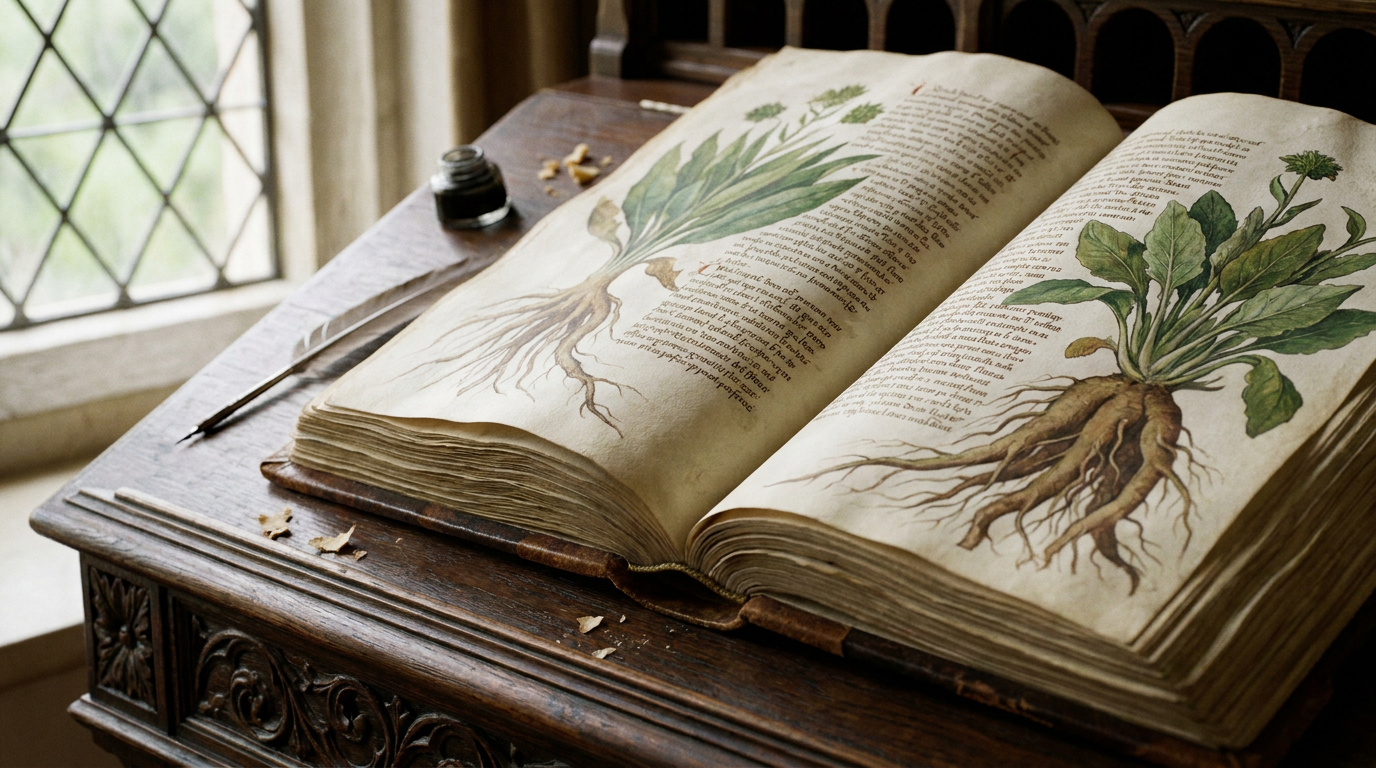
Is the Voynich manuscript decoded? No. Every published “solution” since 1921 has failed to convince specialists, and Yale’s Beinecke Library, which owns it, still describes the text as written “in an unidentified script by an unknown author.” Cryptographic approaches, the library says, “have failed to decipher the text, if it is indeed encoded.”
What has changed is how much we know about the object itself. Radiocarbon tests at the University of Arizona in 2009 dated the parchment to between 1404 and 1438, and that single result killed several of the most popular theories at once.
What the Voynich manuscript actually is
Catalogued as Beinecke MS 408, it is a small vellum book, about 23.5 by 16.2 cm, with 240 surviving pages out of an estimated 272. Yale’s description lists six sections: plants, astronomical and astrological drawings, bathing scenes, cosmological medallions, pharmaceutical drawings of herbs and roots, and short starred entries that may be recipes.
The herbal section alone runs to 126 pages, yet none of its plants can be identified with certainty. That is the first trap for would-be decoders: the pictures look like a key, but they explain nothing on their own.
Video: The Histocrat
The trail from Rudolf II to a Yale vault
According to the Beinecke, Holy Roman Emperor Rudolf II bought the book for 600 gold ducats, believing it was the work of Roger Bacon. The library calls the Bacon link “pure speculation.”
Wilfrid Voynich bought it in 1912 from the Jesuit College at Frascati near Rome. Bookseller H. P. Kraus acquired it in 1961 and gave it to the Beinecke eight years later, a paper trail few puzzles share, the Antikythera mechanism included.
Every claimed decoding, and why it collapsed
| Claimant | Year | Proposed language | Why it failed |
|---|---|---|---|
| William Romaine Newbold | 1921 | Greek shorthand in microscopic marks, by Roger Bacon | John Manly showed in 1931 the “marks” were cracks in dried ink |
| Stephen Bax | 2014 | Near Eastern or Asian language | Self-described “provisional, partial”: 10 proper nouns and 14 letters, no full text |
| Greg Kondrak and Bradley Hauer | 2017 | Hebrew written as alphabetized anagrams | Manuscript experts who reviewed it were not convinced |
| Nicholas Gibbs | 2017 | Abbreviated Latin, a women’s health guide | Lisa Fagin Davis: it “doesn’t result in Latin that makes sense” |
| Ahmet Ardıç | 2018 | A form of Old Turkic | Presented at a conference, not accepted by specialists |
| Gerard Cheshire | 2019 | “Calligraphic proto-Romance” | University of Bristol stated the work was “not affiliated” with it |
Source: Wikipedia, “Voynich manuscript” (read November 25, 2026); University of Bristol statement, May 16, 2019.
A claimant picks a few glyphs near a picture, searches dictionaries until a word fits, then treats the fit as proof. Davis described Cheshire’s method in exactly those terms: “circular and aspirational.”
Gibbs got a spread in the Times Literary Supplement, and Cheshire’s paper passed peer review in Romance Studies. Neither produced a passage another scholar could read the same way.
The hoax theory and why it is weaker than it looks
In 2003, computer scientist Gordon Rugg showed that Voynich-like text could be generated with a table of prefixes, stems and suffixes and a Cardan grille, a perforated card. The catch: the grille was invented around 1550, more than a century after the parchment date.
The text also behaves like language: its word frequencies follow Zipf’s law, as English and Latin do. Physicist Marcelo Montemurro reported in 2013 that content words cluster by topic, and argued a forger would not have known to build that in.
The hoax camp has answers, though. Rugg and Gavin Taylor showed in 2016 that a grille can reproduce many large-scale features of the text, and in 2022 Yale researchers Daniel Gaskell and Claire Bowern found that volunteers asked to write meaningless text produced many of the same odd statistical patterns.
Fresh parchment does not settle the forgery debate on its own, because a later hand could write on old skins. Historian Eamon Duffy points out that this would require at least 14 or 15 whole calfskins of blank 15th-century vellum to survive unused, which he calls “inconceivable.”
What the evidence supports today
Paleographer Lisa Fagin Davis found small, consistent differences in letter shapes between sections but not within them, which points to more than one scribe. Davis puts the number at five, and reads the book as the product of a community rather than a lone hoaxer.
Neither side has a knockout. Language-like statistics do not prove a language, as the Gaskell and Bowern volunteers showed, and five scribes do not prove meaning. What would settle it is one passage that two independent readers translate the same way, and no claimant has produced that.
Like other mysteries once dismissed as myth, this one rewards patience over bold claims, the same lesson the Nazca lines debate taught.
Frequently asked questions about the Voynich manuscript
Has AI decoded the Voynich manuscript?
No. The best-known computational attempt, by Greg Kondrak and Bradley Hauer at the University of Alberta in 2017, proposed Hebrew anagrams, but medieval manuscript experts were not convinced and no readable translation followed.
How old is the Voynich manuscript?
Radiocarbon dating in 2009 placed the parchment between 1404 and 1438. Yale’s catalog gives a broader production window, from the end of the 15th century into the 16th.
Can I see the Voynich manuscript online?
Yes. The Beinecke Library restricts access to the original but publishes high-resolution scans of every page in its digital library, with an option to download all the files.